
Studies: Tributes to Manchán Magan
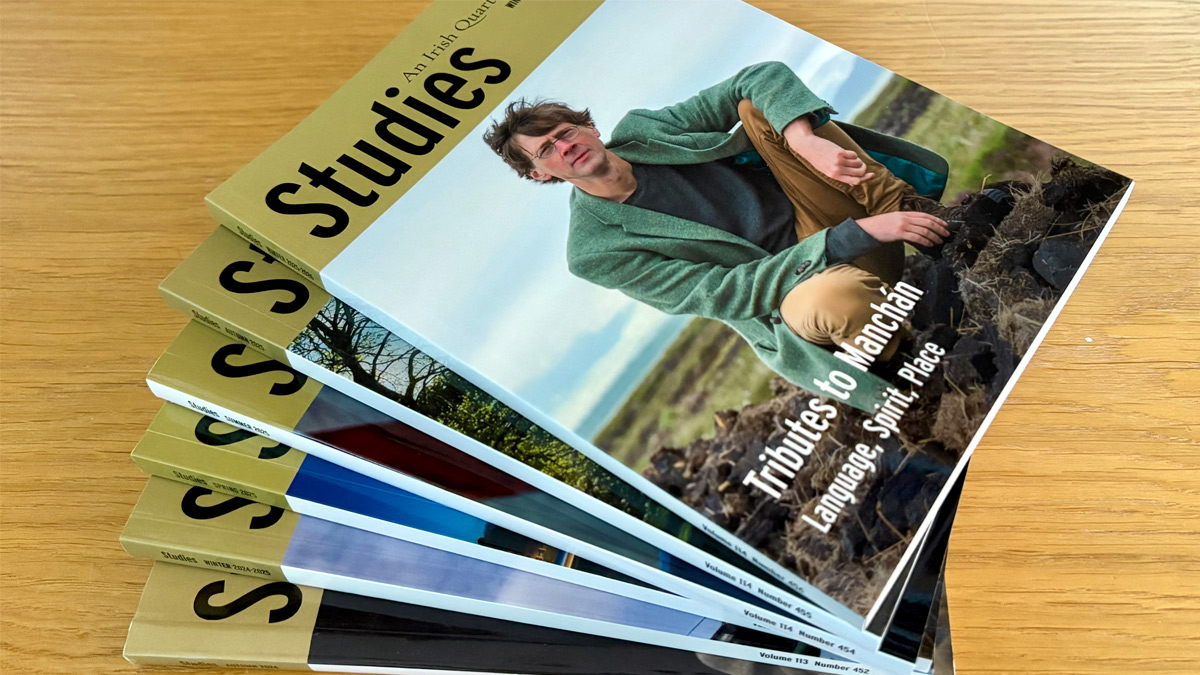
The winter 2025 issue of Studies commemorates Manchán Magan, the writer, documentary maker, and broadcaster who died on 2 October 2025. Manchán’s funeral – or ‘liturgy of remembrance and farewell’ – was held on 6 October in the chapel at Gonzaga College, Dublin, his alma mater. Many people gathered to celebrate his life through story and song. One of those who spoke was Tom Casey SJ, who visited Manchán just days before he died, when he found him ‘frail, yes, but “bríomhar fós”, still full of life’. In ‘The Fifth Province: A Tribute to Manchán Magan’, an extended version of the words he spoke at the funeral, he presents Manchán as a prophet – ‘not one who foretells the future, but one who tells forth into our present, who speaks with the voice of the spirit into the silence of our forgetfulness’.
In ‘Influence in Transmission: Scéal an Deisceabail Teanga’, Liam Mac Amhlaigh concurs in thinking Manchán a ‘prophet’, but he proposes that he was also ‘a disciple of the language’. Manchán put the Irish language at the centre of his work, even when he travelled beyond the country’s shores, so he not only challenged Irish people to reflect on their own valuing of the language, but he also brought Irish into conversation with other minority cultures and indigenous communities throughout the world.
Nuala King recounts an exchange she had with Manchán regarding the Aboriginal Australian concept of ‘Kanyini’, a sacred principle of ‘caring and practicing responsibility for all beings and for the land that sustains them’. In ‘Holding the World Together: Myth, Language, and the Reawakening of Kanyini in the Irish Imagination’, she explores resonances between this concept and the’ deep ecological consciousness embedded in Irish myth and language’.
Siobhán McNamara ran the library and was Green Schools Coordinator in Gonzaga College for a number of years, and her work included bringing guest speakers to the school to address the students. In ‘Memories of Manchán’ she recalls Manchán’s occasional visits when he entertained his audience with stories from his travels, his projects, and his school days. True to form, he would speak in Irish, but he always made sure that he didn’t leave his listeners behind.
What all the essays in this short series of tributes have in common is an affirmation of what McNamara thanks Manchán for at the end of her essay – his energy, sincerity, creativity, and eloquence.
***
Other essay contributions to this issue of Studies include Bryan Fanning’s ‘Immigrants, Diasporas and Faith-Based Welfare’. Fanning notes a pattern that has held in many places around the world whereby vulnerable migrant groups rely inordinately on informal community care, especially that provided by faith-based organisations. In ‘Literature as Theology: A French Paradox’, Kevin Williams observes that, in spite of the official policy of laïcité in France, religion continues to have a prominent place in the country’s public culture and religious concepts are transmitted as a live cultural resource through literature. Is there a model for Ireland here?
In ‘The Impact of Demography and Migration on Employment in Ireland’, Martina Lawless and Tara McIndoe-Calder build on their chapter in the recently published 15th edition of The Economy of Ireland. They chart the shifts in the Irish population since the Great Famine, through both natural increase and swings in net migration, noting in particular that both inward and outward migration is driven by concerns over access to labour markets.
Carmel Gallagher reflects in ‘Life to the Full: The Experience of Returned Irish Missionaries’ on Ireland’s failure to value the work and experience of missionaries, whose contributions to the material development and to the pursuit of social justice in the Global South have given Ireland considerable ‘soft power’ in international relations.
James Kelly observes in ‘Roman Catholicism at a Crossroads’ that the Church today is experiencing the same rift between traditionalists and progressives that it did during the modernist crisis of the early 20th century, a rift that has its origins in the increased rationalism and dogmatism of the institutional Church in the years after the Reformation and the Council of Trent. If the rising tide of internal discord and external decline is to be stemmed, he argues, the Church will have to be more open, inclusive, and dynamic.
In ‘Catholicism, Motherhood, and Intergenerational Agency in Elaine Feeney’s As You Were’, Kate Costello-Sullivan engages with Feeney’s 2020 novel about a a group of women who find themselves in the same hospital ward, each of them victims of the state’s ‘architecture of containment’ and often the Catholic Church’s collusion with it.
Two review articles complete the essays of this issue. Peadar Kirby, in ‘Uncovering the Deep Crisis of the Liberal Status Quo’, brings two recent publications together, Tim Jackson’s The Care Economy and Dan Davies’s The Unaccountability Machine, and identifies an important commonality between them. They both challenge the assumption that the response to the rise of the far right is to return to the liberal status quo. A far more radical socio-economic transformation is needed. And in the second review article, ‘Agent of the Impossible’, Ursula Halligan reflects on the continued failure of the Catholic Church to see and treat women as equal members of the Body of Christ. She does so in the light of Soline Humbert’s A Divine Calling: One Woman’s Life-long Battle for Equality in the Catholic Church, in which Humbert tells the story of her hearing ‘the call to priesthood’ many years ago and failing since then to have churchmen take her seriously.