

Faithful Justice Today: A Jesuit Commemoration
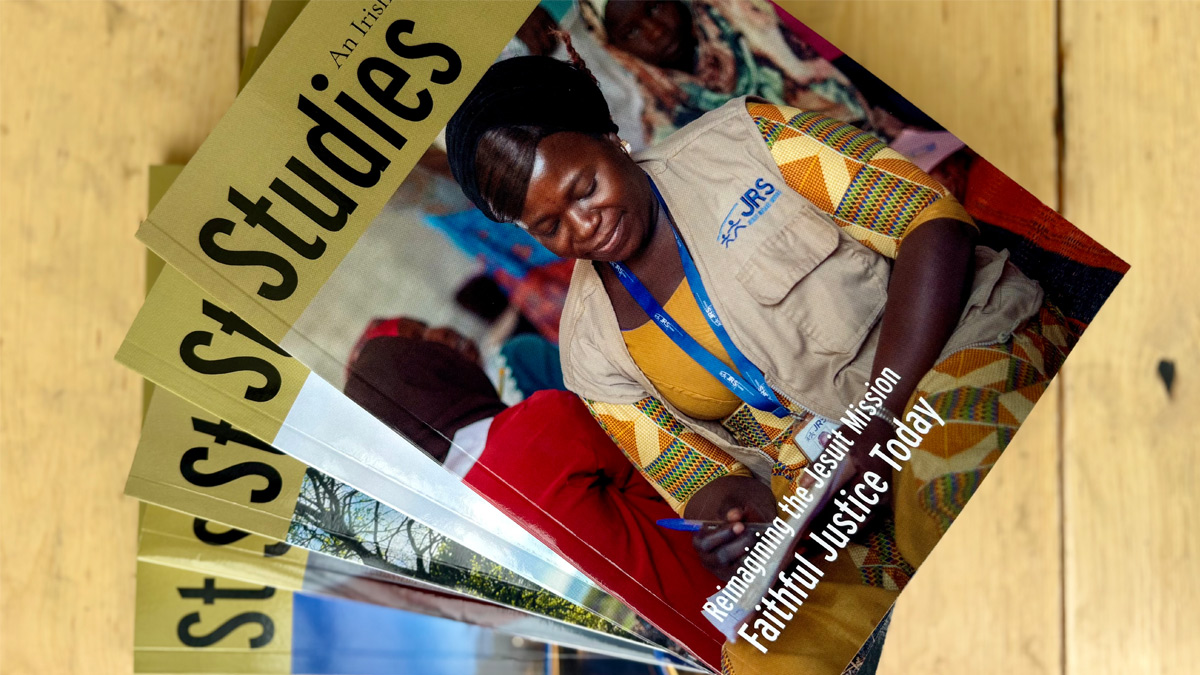
The spring 2026 issue of Studies: An Irish Quarterly Review commemorates the 50th anniversary of the Jesuits formally committing the Society to ‘a faith that does justice’ at the 32nd General Congregation (GC32) in 1975. A symposium on this theme in the Loyola Institute, TCD », in November last year had six papers addressing aspects of the theme, all six of which are published in the spring issue. The purpose of the symposium was to reflect upon this commitment and on its legacy over the past fifty years
In a foreword, the Irish Jesuit Provincial, Shane Daly SJ, explains that the Society’s decision in GC32 was not a rejection of its commitment to evangelise but a commitment (quoting an American Baptist theologian) to “the old message of salvation but enlarged and intensified”. In relation to Decree 4 of the General Congregation, perhaps its central text, Fr Daly adds that it was
the beginning of the new chapter rather than a new book in the story of the Jesuits. The commitment remained the same, to create a more humane and liveable world, but the means expanded beyond charity and challenging personal sin, to analysing and acting to overcome the sinfulness of the social order, and undoing permanent structures that oppress, extort, and deny opportunities for flourishing whether human or ecological.
Fr Daly then introduces the six papers, which are now carried in Studies:
the years following GC32 were rich with courageous and creative initiatives, but also controversy and disorientation (the story of the theology of liberation is perhaps the most well-known sub-section of this chapter). Two Jesuits, Gerry O’Hanlon and Michael Kirwan, give something of the favour of these unsettled and unsettling decades.
Most painfully, Marie Keenan’s reflections on the clerical sex abuse crisis and Suzanne Mulligan’s exploration of gender justice remind us that the Church is not immune from illegitimate uses of power and unjust structural arrangements, which oppress and harm. Anupama Ranawana brings to the fore our new awareness of the victimization of our common home while Kevin Hargaden, a social theologian, stresses the need for Christians to work in partnership, especially in countering distorted and weaponised versions of the gospel.
Apart from these papers on the Jesuit commitment to a faith that does justice, there are various contributions, some of which concern themes related to the symposium papers. In a reflection on his education by the Christian Brothers, Fiachra Long remembers being inspired by the example of the Jesuit brother Vicente Cañas, who immersed himself in the life of the Enawenê-nawê people of the Amazonian rainforest in Brazil, defending their community life and land rights until he was slain in 1987 by a police deputy acting on behalf of landowners who coveted the tribal lands.
In ‘Regulation and a Fair Society’, Tara Mitchell and Francis O’Toole outline regulatory policies in Ireland and treat of the debates that these policies have given rise to. Alex Kane takes a wide view of contemporary unionism in Northern Ireland in ‘Unionism and the New World Order’, especially its response to the rise of the populist right. In ‘Intégrisme: The Rise of Modern Political-Catholic Integralism’, James Kelly fills in the 19th century backstory to present-day attempts to revive integralist solutions in the name of postliberalism. And in another essay, Alexandra MacLennan recounts the fortunes of the Irish Anti-Apartheid Movement, founded in 1964 by Kader and Louise Asmal.
Also featured here are four poems by Ciarán O’Rourke. Included are two striking poetic re-renderings of passages from Pliny the Elder’s Naturalis Historia.