
JCFJ partners with the EU on housing
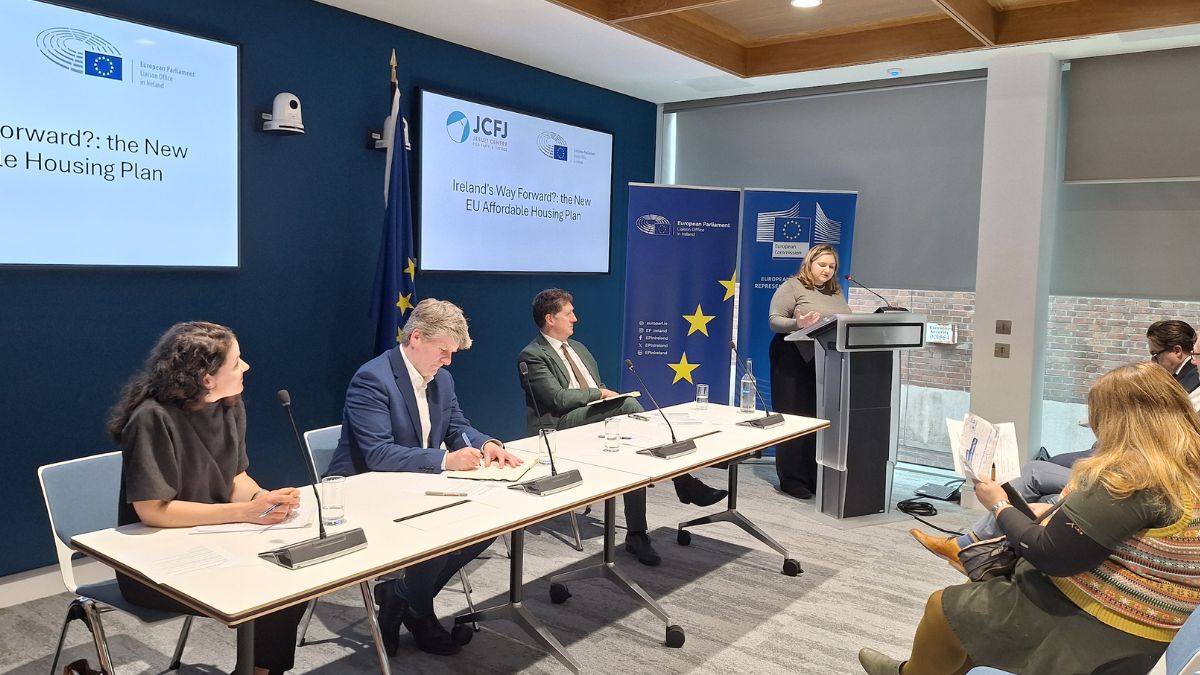
The Jesuit Centre for Faith and Justice (JCFJ), in partnership with the European Parliament Liaison Office, has begun a national conversation on how Ireland can fully embrace the EU Affordable Housing Plan and leverage the Plan’s framework to deliver more affordable, secure, and sustainable housing. The Plan is widely seen as a crucial tool for tackling the country’s deepening housing crisis.
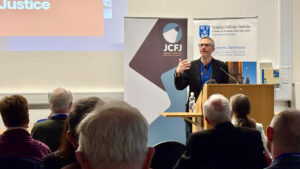
The conversation began with an event on Tuesday, 24 February 2026, at the European Parliament Offices on Balfe St, Dublin. The JCFJ says that with more than 16,000 people officially recorded as homeless — figures that account only for those in emergency accommodation — the urgency was unmistakable. Ireland’s housing crisis, driven largely by escalating costs, has intensified over recent years. Speakers repeatedly emphasised that meaningful, long-term solutions require coordinated policy, political will, and a shift in national thinking.
Call for a 50-Year Mindset
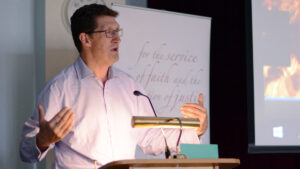
The keynote speaker, Former government Minister and Chair of the EU Housing Advisory Board, Eamon Ryan, opened the discussion by highlighting the need for a fundamental “paradigm shift” in how Ireland approaches housing. “We need to look at housing through the lens of 50 years in the future,” he said, “rather than seeing housing as an asset you can flip.”
He summarised some of the central themes of the EU Affordable Housing Plan, including:
- A broader definition of affordability that includes lifetime costs, utilities, health, and carbon impacts
- The importance of social justice and a Housing First approach
- The need to boost supply while regenerating existing housing stock
- The expansion of cost-rental models, inspired by the success of Vienna
- Consistent European data standards to inform policy
- The potential of rural areas to alleviate pressure on urban centres
- The critical role of Modern Methods of Construction (MMC)
While acknowledging the substantial state investment currently allocated to housing, Eamon Ryan warned that spending alone is not enough. “You could borrow more,” he said, “but if you don’t have the money for the transport system, then the housing won’t work.”
He also pointed to a political challenge that often goes unspoken: resistance within affluent communities to new housing. “Existing communities are saying no,” he said. “This is our biggest problem… politicians are very attentive to existing constituents who vote.” The result, he argued, is a system that disadvantages younger generations who can no longer afford to live in the places they grew up.
Modern Construction, Old Bottlenecks
Paul Tierney of MMC Ireland (one of the leading representative bodies and voices for the Modern Methods of Construction sector, promoting innovative and sustainable building techniques to transform Irish construction). stressed the promises and challenges of factory-built and modular construction. MMC, he explained, involves assembling high-quality, pre-fabricated components off-site, a process used widely across Europe.
However, Ireland faces a significant bottleneck: certification. “All housing development has to go through rigorous testing,” Mr Tierney said, noting that approval from the National Standards Authority of Ireland (NSAI) can take up to three years. This delays innovation and undermines the scaling of MMC nationally. Harmonising standards across EU member states, he argued, would unlock more efficient and sustainable housing production.
Young Adults Most Affected
Dr. Marie Hyland, Research Officer at Eurofound, presented stark findings on housing affordability for young adults across Europe. Affordability, she reminded the audience, is not just about prices; it’s about income.
In Ireland, as in countries such as Bulgaria, Portugal, Spain, and Poland, Eurofound’s research shows that young adults in many regions must spend more than 80% of their income on renting a basic starter flat. This far exceeds the commonly accepted affordability threshold of 30%.
The consequences are severe. Between 2018 and 2023, the proportion of 25–34-year-olds living with their parents rose from 23% to 40%—the steepest increase in the EU.
“This affects career decisions, delays family formation, and harms both mental and physical health,” Hyland said. “Policy makers need to take these challenges seriously and prioritise quality, supportive housing for young people.”
A Values-Based Approach
Closing the event, Dr. Alexia O’Brien, Housing Policy Advocate for the JCFJ, argued that Ireland’s housing struggles stem partly from an over-reliance on private, especially foreign, investment since the last recession. Tax incentives, vulture funds, discounted public land, and the growth of institutional landlords, she said, have reshaped housing into a profit-generating industry rather than a social good. “What’s left,” she noted, “are apartments and homes that the average person can’t afford.”
Dr O’Brien called for a values-driven, holistic approach to housing policy, one that sees a home not just as a commodity but as a foundation for dignity, safety, and equality.
“Housing shouldn’t be something you must earn the right to,” she said. “We need active, preventative measures, not constant firefighting after problems have already broken out.”
She urged Ireland to fully commit to the EU Affordable Housing Plan rather than selectively adopting elements. “We have a good way forward,” she said. “As an EU, as a country, as a city. But we should be fully embracing it.”
Four Pillars for Change
The EU Affordable Housing Plan is built around four key pillars:
- Boosting supply
- Mobilising investment
- Enabling immediate supports while pursuing long-term reforms
- Supporting those most affected by the crisis
Dr Dáithí Downey of Dublin City Council chaired the event and said that the conversation marked only the beginning of a broader national engagement.
As tensions rise across Europe and trust in institutions continues to be tested, Eamon Ryan concluded with a hopeful message: “If we can show people that the centre can not just hold, it can build, we can make a real difference.”