
‘Community, punishment, forgiveness’
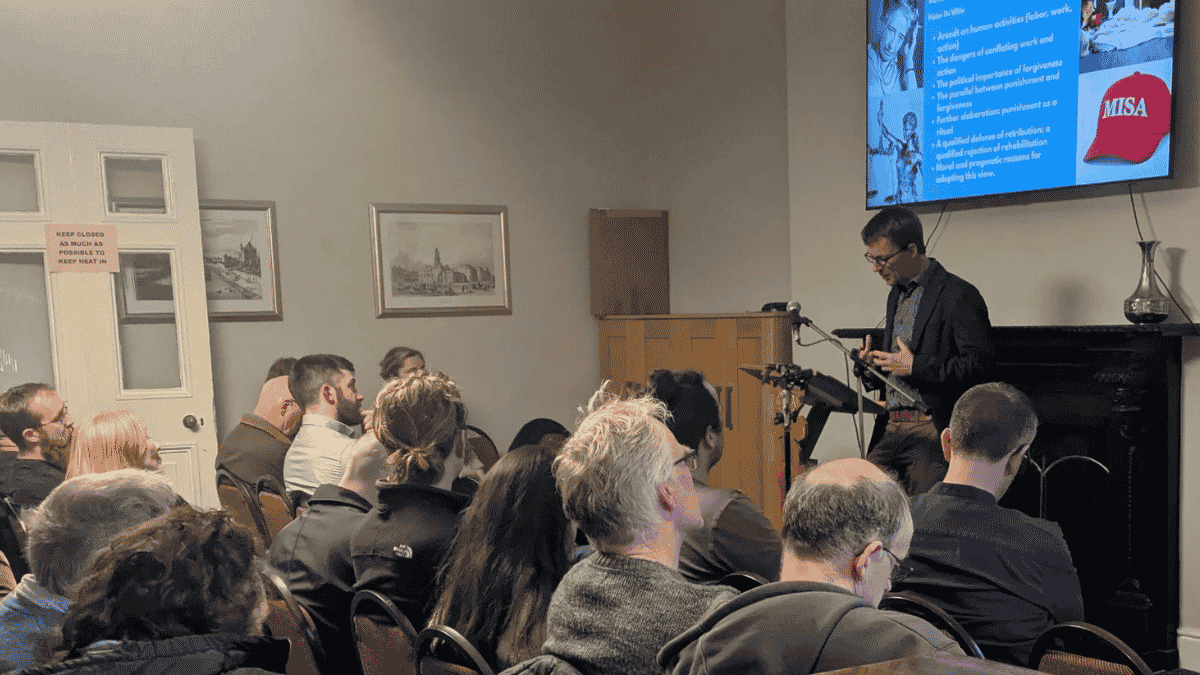
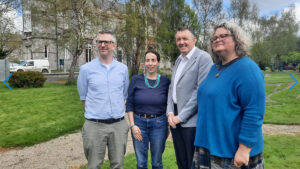
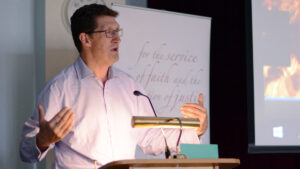
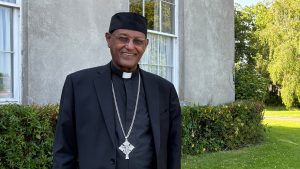
There was standing room only when people gathered to hear Prison chaplain Professor Pieter De Witte, deliver the annual Jesuit Centre for Faith and Justice (JCFJ) lecture in the John Sullivan Room in Gardiner Street, 21 April, 2026. The title of Dr Witte’s paper was, ‘For we know not what we do. Reflections on Punishment, Community and Forgiveness’. Bishop Martin Hayes, who serves as the Irish Catholic Bishops’ Liaison to the Irish Prison Service and to the Northern Ireland Prison Service, was one of the attendees gathered to reflect on the place of punishment and prison in Society.
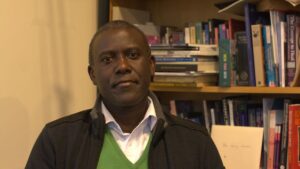
Dr De Witte, from the Katholieke Universiteit Leuven, Belgium, is a prison chaplain and visiting professor at the Chair for Detention, Meaning, and Society, a position funded by the European Low Countries Jesuit province. Read more below from Cherise Boraski, of the JCFJ.
The Importance of ‘Not – Knowing’
Professor De Witte delivered a stimulating and provocative paper, prompting attendees to reflect on the role of punishment and the place of prison in society. In part one of his lecture, he addressed the crisis in our penal systems from a political-philosophical and theological perspective. Starting with Christ’s prayer to forgive his executioners because ‘they know not what they do,’ he turned to Hannah Arendt’s work on forgiveness, showing how a politically sound response to wrongdoing involves recognising ‘not-knowing’ on the part of both the offender and the punishing authority.
In part two of his paper, the Christian (Augustinian) idea of community was highlighted as centring on a ‘mystery,’ once again pointing to something that withdraws from the field of knowledge and control.
In the final section of his address, lessons were drawn from these reflections on forgiveness and community regarding the way we organise our penal systems. Dr Witte argued that a reductionist vision of criminal justice must take this not-knowing into account, and he elaborated on this idea in terms of
punishment as retribution and as ritual.
These are particularly timely insights as Irish prisons are deeply crowded with 600 men and women sleeping on the floor each night on mattresses or camp beds. Over 300 psychiatric patients languish in prisons with no treatment. Yet, the Government’s solution is to build even more prisons. It becomes a moral imperative to ask how much punishment is enough in our society.
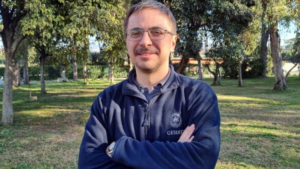
After the paper concluded, Dr Kevin Hargaden, Social Justice Theologian, chaired a question-and-answer session as attendees considered aspects of the paper, particularly in relation to long prison sentences.
The full talk is available here » and will be published in the Winter 2026 issue of Studies ».
Cherise Boraski,
Operations Officer,
JCFJ
May 2026.