
The grasp of grief
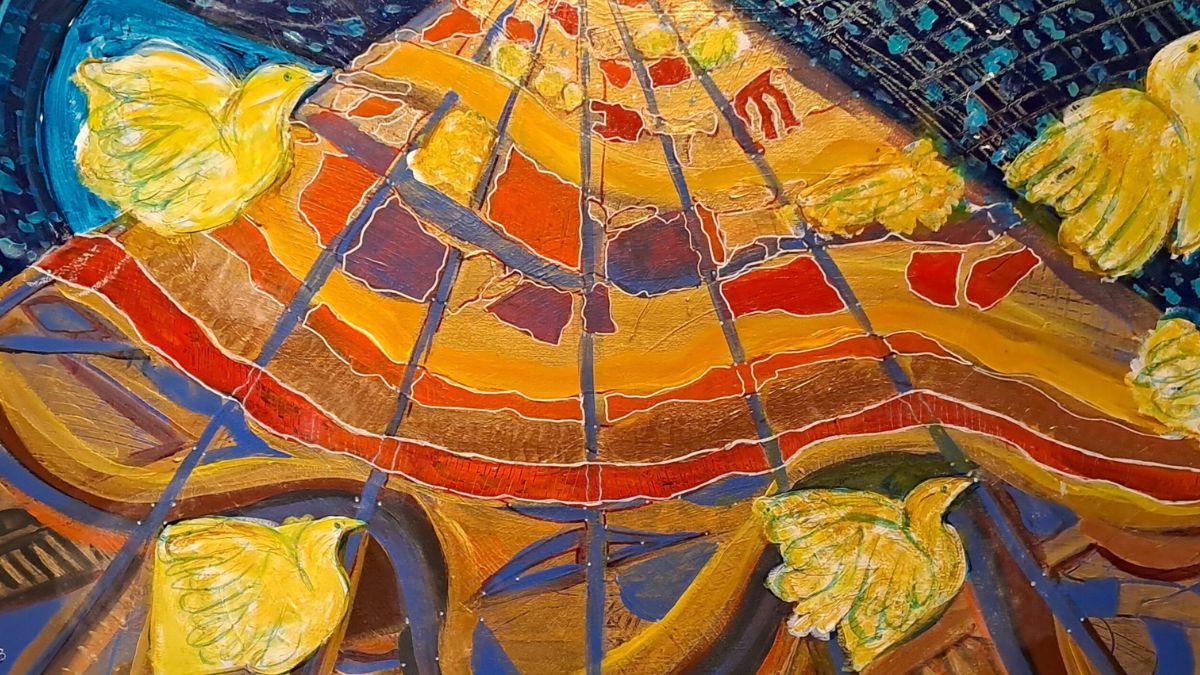
Colm Brophy :: The picture I have painted here is a symbol of the world’s uncertainty of its own destination. We are gripped by this uncertainty when we experience our world empty of warm human values, our politics empty of kindness and unable to communicate truthfully. And when power and wealth, without a thought for the poor, look to place more power and wealth where it is not needed.
Picasso has both painted and sculpted images of the dove of peace. He refers to it as the dove caught between the First and Second World Wars. Leonard Cohen picks up the same image in his lyrics: “The wars, they will be fought again, the Holy Dove, it will be caught again, bought and sold and bought again. The dove is never free.”
The world has been put through an immense experience of grief through the wars of the past few years. Vast populations have been led into unthinkable suffering and death. Millions have been traumatised. If we, distant onlookers at our TVs, have not also in some way been traumatised, there is probably something wrong with us. Who hasn’t wept to see horrific war crimes on our screens? Grief grips us. Who hasn’t been depressed at our own helplessness in the face of so many injustices? Along with that are our own losses, our many deeply personal moments of grief, which may dwell in us for decades and spring up to face us with our unresolved grief.
Bob Geldof, in a recent interview with Brendan O’Connor, described how, while stopped at traffic lights waiting for the green, he suddenly burst into tears, overcome with emotion many years after the death of his wife and his daughter’s suicide tearing at his heart. We each face our own losses. Personal grief can cling to us over a long distance for a long time. The loss of my parents remains quiet but never far away. The untimely death of my brother is more difficult to quieten. Our litanies grow longer as warm friendships and relationships of trust disappear.
What happy decades of friendships have gone. The grim reaper does not hesitate. The loss of constant community support, through my own choice, is gone. My long, drawn-out decision to leave the Jesuits has brought me inner peace. And yet, at the time of departure, seeing my name on a list in the Zambian catalogue under the heading “Dismissed from the Society” suddenly shocked me. It threw down before me the reality of leaving good Jesuits, brothers, friends, and communities. But the inner joy and peace of my decision did not leave me. I felt drawn below the surface, facing the silence of being fully responsible for my own decision. I remembered what a Cistercian abbot had said to me during my tertianship in Lafayette, Oregon. “Go deeper,” he said, “go deeper.”
So, swimming down on the ocean floor, still on my first breath, I remain happy with all that I have received in my family life and grateful for the kindness I have received, having left. All that I learnt from the people of Zambia enriched me, and all that I was trusted with in my pastoral and administrative work in Zambia and Malawi taught me so much. And I am grateful for all that I am becoming with the help of Mable’s wise, good-humoured, hardworking, and truthful presence in my life.
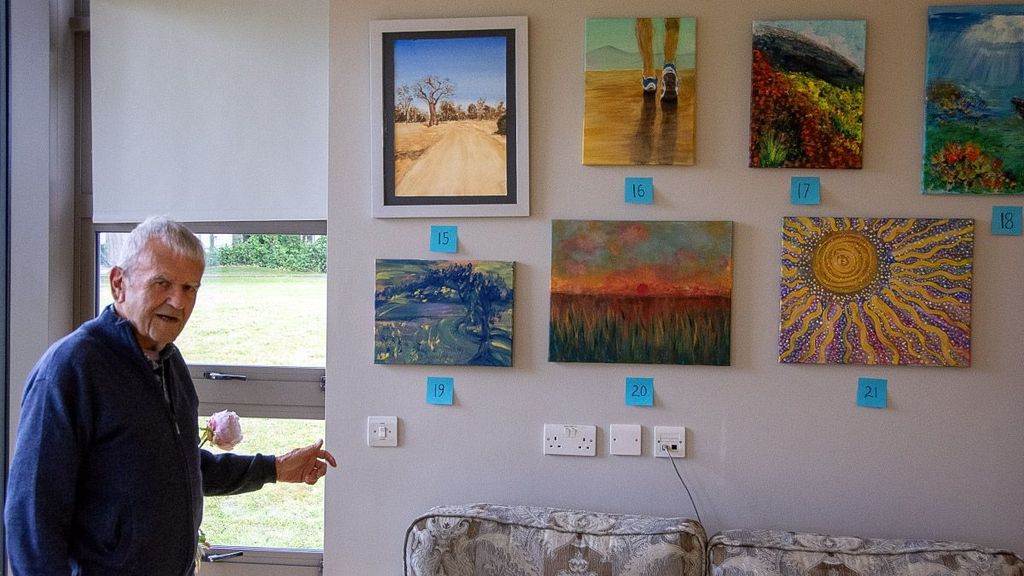
So then my painting today raises for me an awareness of unfinished political history. But more than that, it is a reflection of the simple lifestyle lived out, with a very low carbon footprint, by the valley of Tonga in Zimbabwe. They have suffered much and been neglected often. The painting reminds me of how the strong values, domestic skills and traditional insights of wisdom are passed on from generation to generation through the rich subtleties of language when close-knit communities survive. Welcome, respect, and generosity are immediately noticeable to the stranger.
Added to this is the joyful dancing, singing, and drumming that create a community-bonding woven through many rituals. Birth rituals, initiation rites, marriage customs and funeral rites, all of the pre-Western and pre-Christian traditions, were as much guided by the Holy Spirit as those brought by missionaries. They are the unrecognised chapters of the Bible, both Old and New Testaments, that exist in every culture, often with little acknowledgement.
Unwittingly, good-intentioned missionaries went all over the world to pre-Christian communities to bring them the Bible and convert them to Western Christianity, using the word ‘pagan’ unhelpfully and too often. While much good was done in education, agricultural development, and healthcare by our missionaries, the sad fact is that they generally forgot to drop the ‘western’ part of the Christianity they brought. Instead of integrating the valuable ‘scriptures’ of people’s cultures and traditions into an expression of Christian faith, we used the word ‘pagan’ and insulted with the word ‘primitive.’ Cultures and sacred traditions were badly neglected for much too long.
But there were exceptions. The late Fr. Frank Wafer S.J. spent his life shining a light on the jewels of Tongan culture. He spent decades travelling through rural villages, collecting traditional music and promoting the language by recording oral histories, stories, and proverbs. He produced a unique Tonga-English dictionary.
Through a long series of seminars with talented Tonga people, he enabled the production of volumes of traditional hymns composed by local people. The ‘new’ music exclusively used the very old traditional music of the Tonga people, while at the same time referencing worldwide sources of Christian faith in the Bible and liturgy. He also encouraged Tongan authors to produce more Tongan literature useful for schools and third-level studies.
Through a cultural centre named Mukanzubo (meaning the mythical wife or mentor of the culture over the ages), he helped people develop the practice and love of many old cultural traditions, dances, food and dress. Cultures live through being close-knit communities, but sadly can die under social and political pressures. Their regeneration runs along the battle lines of truth and genuine wisdom in today’s social medisa which can itself be a great creative source of new life for unknown cultures. I can open my phone, for instance, and turn on Kazyula Nkumba (Radio Chikuni) any time I want to hear the local Tonga or Zambian national news, or a variety of other Tonga programs.