

Marking 50 years of faith and justice
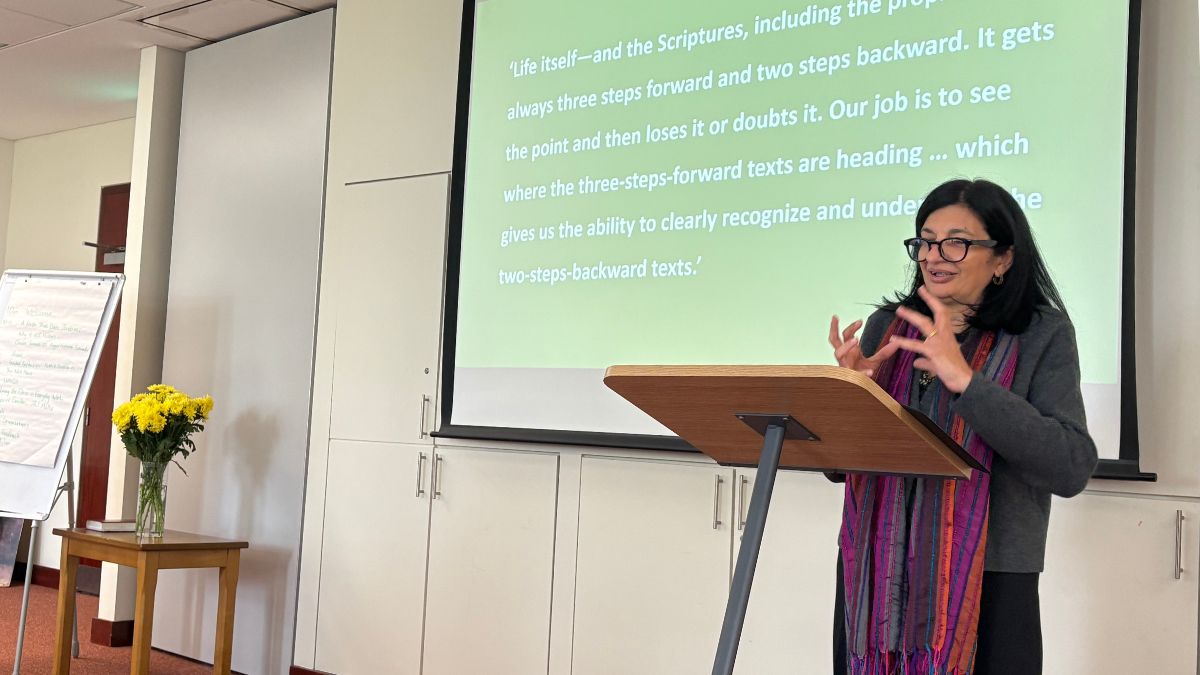
Directors, Jesuits, and lay collaborators in the Social Justice Apostolates of the Irish Province gathered in Manresa Jesuit Centre for Spirituality, on Friday 10 October 2025, to celebrate 50 Years of a ‘faith that does justice’. They listened to talks on the subject before reflecting in smaller groups on what a ‘faith that does justice’ means for the Order and its colleagues today, and what it should mean into the future.
Keynote speakers Katerine Camilleri (see photo) from JRS Malta and Cesare Sposetti SJ of the Italian Jesuit magazine Aggiornamenti Sociali » shared their personal perspectives on what a ‘faith that does justice’ meant for them in their varying works.
Katerine, who is a lawyer by profession, spoke about the increasingly difficult situation for migrants and refugees in Malta. She explained how the Maltese government was implementing measures designed to make the island an inhospitable place for migrants, preventing those who try to come for refuge from settling there, and re-locating those already in detention or even in paid employment.
She shared about her own faith journey, and she spoke also of the difficulty of trying to witness to God’s love in a detention centre, or on the island itself, where many migrants are homeless or destitute. “Detention is dark and awful,” she said, “but also full of huge stories of faith, resistance and hope.” She explained how “people supported each other in those centres in the hope that one day they will be free.” In this way she noted, the question is not how we bring Jesus into a detention centre but how we develop the capacity to recognise Him. “Jesus is already there in detention.” she said, “We don’t bring Him in. All we have to do is open our eyes.”
Cesare Sposetti SJ also made an impact on those present, as Dr Kevin Hargaden, the JCFJ’s social justice theologian, explains: “He guided us through the relationship between justice work and Ignatian spirituality in a presentation entitled: ‘A Faith That Does Justice: Why It Still Matters’. He traced how the Jesuit mission – rooted as it is in the Ignatian contemplation on God looks upon the world – calls us to respond to the suffering and needs of our time. A ‘faith that does justice’ might be a slogan that is turning 50 years old, but it is a sentiment we can find from the very beginning of the Society. Building on a careful examination of Decree 4 of General Congregation 32, Fr Sposetti showed us how attending to our own personal spiritual movements of consolation and desolation is a way to engage in social and political struggle. It was a really remarkable talk that allied his longstanding engagement at the forefront of justice issues in Asia and Europe with this winsome, accessible, but profound spirituality.”
As well as keynote talks, there was also plenty of time for guided reflection and sharing, led by Brendan MacPartlin SJ, the Social Justice Delegate, and Brendan McManus SJ, who works in the Manresa retreat centre.
As one JCFJ member put it: “Justice is about more than passing on knowledge. It’s about creating spaces and works to help form people who will challenge unjust systems. This day was a chance to not only celebrate to but to share and support one another in our work, and reflect on what is calling out to us into the future.”
Background information.
The JCFJ explains how fifty years ago, in 1975, Jesuit leaders gathered in a major meeting (General Congregation GC32) and agreed on a statement that still shapes who they are today. They declared that their mission was to share the Christian faith in a way that always includes working for a fairer and more just world.
This meant that schools, parishes, and other Jesuit works should not only pass on knowledge or offer spiritual guidance, but also form people who would stand with the poor and challenge unjust systems. The decision was costly. Many Jesuits later faced opposition, and some were murdered for their commitment to justice. But GC32 is widely acknowledged to have given the Jesuit Order a renewed sense of direction. Their statement, known as ‘Decree 4’, remains foundational for how Jesuits understand their work in today’s world.