
WW11 – ‘A humanitarian disaster on a global scale’
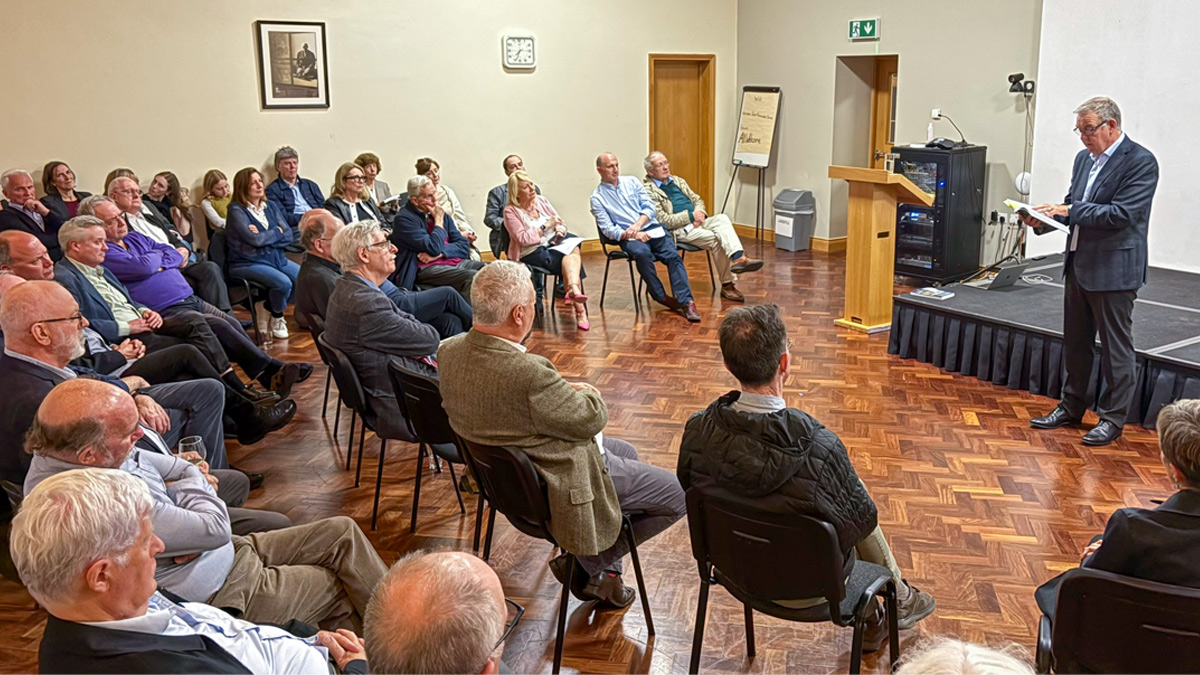
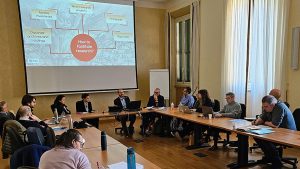
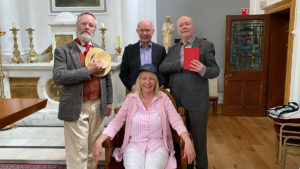
Jesuits, colleagues, and friends attended the launch of The Second World War through Jesuit Archives: The Case of Europe (1939-1945) on Wednesday, 30th September 2026, at 7 pm, in the Jesuit Curia, Milltown Park, Dublin. Bryan Dobson, former RTÉ newsreader and now Chair of the State Commemorations Advisory Committee, launched the book. Damien Burke, the Irish Province Archivist who co-edited the book, also spoke at the event, which also featured an exhibition of archive material on the topic.
Dobson picked out for special attention the story of Michael Morrison SJ, who suffered psychological trauma from his experience at the liberation of the Bergen-Belsen concentration camp. On 11 April 1945, Fr Morrison wrote to his Provincial in Ireland: “I have seen some of the pictures reproduced in the papers, but they fall very short of giving a proper idea of the horrors of this place… What we met with in the first days is utterly beyond description.’
Morrison added: “The work here has been physically the most rewarding that I’ve been called on to do, but it has also been the most consoling. Even if I had done no other work since I joined up, I consider my four years in the army worthwhile.”
“That’s an extraordinary, direct testament from an Irish Jesuit who was there at the liberation of Bergen-Belsen,” Dobson remarked; “It just underlines the power of the original material, the power of the archive, to bring you right back to that moment. You can almost stand with him, and in your mind’s eye see what he was witnessing in those terrible days.
As co-editor of the book, Damien then described the genesis of the project. There were two main influences on the editors. Firstly, the Jesuit General Congregation 36, in 2016, encouraged collaboration and networking between provinces, and secondly, in 2019, Pope Francis decided to have the Vatican Archives release all the material relating to the pontificate of Pope Pius XII. As Jesuit archives tend to align their policies with those of the Vatican Archives, a group of province archivists around Europe agreed to collaborate on a project relating to World War II, which took place entirely within Pius XII’s pontificate.
The book is the collaborative work of archivists Damien Burke (Ireland), Rebecca Somerset (United Kingdom), and
Christian Taoutel (Lebanon), and part of a project coordinated by the Roman Jesuit Archive (ARSI), in collaboration with the Province Archives of the Jesuit Conference of European Provincials (JCEP). Below is a summary of what they conceived the project to be.
Jesuits and the Second World War
The Second World War changed the world’s economic, political and social order. It was also a humanitarian disaster on a scale never before seen in world history. How did the Jesuits in Europe endure this global conflict? And what Jesuit archives can be explored for the years 1939–1945?
This is the first time that archivists from the Jesuit Provinces of Europe and the Eastern Mediterranean have collaborated to make the Jesuit experience of the Second World War accessible to specialists and general readers. The book showcases collections from Jesuit Archives – together with historical overviews – for the years 1939–45, in Britain, Czechia, France, Germany, Greece, Hungary, Ireland, Italy, Lebanon, the Low Countries, Malta, Poland, Portugal, Slovakia, Spain, and the world headquarters of Jesuit Archives in Rome.
The project’s aims set clear parameters: for archivists to produce an introductory, informative and attractive guide to showcase material held by European Jesuit archives relating to the period 1939–45. The intention was not to produce a definitive guide to the collections on the subject, but rather a useful overview as the basis for possible starting points and research directions for scholars interested in this topic, and an entry-point for those seeking to explore the archival collections more generally.
The war years were a time of profound disruption for the Society of Jesus, as for the wider world. Many Jesuits were conscripted or volunteered for military service, often as chaplains, while others faced imprisonment, deportation to concentration camps, or execution.
Jesuit properties suffered damage, confiscation, or conversion to wartime use, severely limiting the Society’s educational, pastoral, and social justice work. Yet, despite these hardships, the Society’s global membership continued to grow during this period, with Europe remaining central to its mission and identity.
In seeking to present some of the core holdings from the archives, it was essential to emphasize that this volume is not intended to present a triumphalist or idealised view of the Society’s involvement during the war – even though some of the documents being surveyed express such sentiments. Archives are not neutral repositories of information: they reflect specific priorities, biases, and worldviews from the period in which they were produced and require the work of scholars to sift, interpret, and analyse their contents.
In offering this survey of available materials, it is hoped that more research will be undertaken in this field, prompting readers to engage with the significant gaps in the current historiography. Future scholars may delve deeper into critical topics that deserve further scrutiny such as: the relationship between Jesuits and fascism; antisemitism within the Jesuit community and the
defence of Jewish populations; the broader role of the Jesuits in wartime resistance movements; the impact of the war on Jesuit educational institutions and pastoral work; Jesuit interactions with totalitarian regimes; colonialism and the role Jesuits played.
The Second World War through Jesuit Archives: The Case of Europe (1939-1945) is available to purchase on ‘The Way Ignatian Book Servic » and on the ‘Fondazione Polanco’ website ».