

Are humans doomed to be predators?
Bill Toner SJ :: During one summer in the 1950s, as a teenager, I worked briefly in an ice-pop factory in a poor area of Dublin. Production controls were sloppy, to say the least. One of my abiding memories of these pre-automation times was watching the young boys licking the ice-pops before they slid them into their cellophane package. I never consumed another ice-pop in my lifetime!
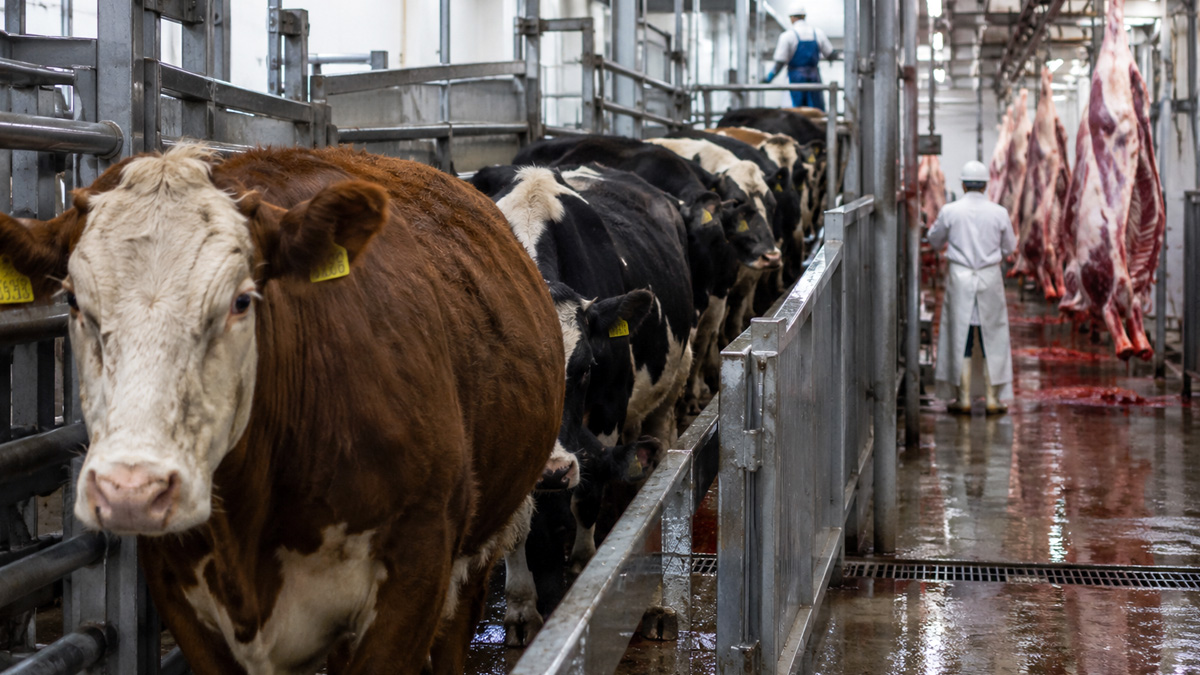
If we were to venture into close contact with the practices in some of the ‘factory farms’ in Ireland, which are the source of our chicken fillets and pork chops, I wonder would it permanently put us off these popular foods? At least in Ireland our climate makes it unnecessary to lock cattle up day and night in huge sheds, as happens in many countries, but our pigs and chickens are not so fortunate. Leg pain in farmed chickens is the world’s largest animal welfare problem. The chickens’ legs cannot bear the weight of their unnaturally large breasts, causing ruptured tendons and twisted legs. Other horrors of factory farms are easy to find online.
Because of the effect of medication prescribed for a particular condition, I have been encouraged by doctors to include meat and fish in my diet. So, I cannot claim to be an apostle for veganism. Nevertheless, I do not always rest easy as a meat-eater. I have always been fond of animals, and find them a source of great interest, especially since the proliferation of TV programmes which study their behaviour. I am both horrified and fascinated by shots of big cats or wild dogs ambushing their prey and bringing them to a gory end. But I can’t help thinking that basically we are no different from these predators, even if our diet is more varied. Every year, humans slaughter roughly eighty billion land animals and more than 1.2 trillion aquatic animals for consumption.
There are number of reasons, arguments, and even underlying ideologies which have led to humans becoming enthusiastic meat eaters. Or not. Unfortunately, it is not easy to have a civil discussion about meat-eating as, particularly in recent decades, views have become very polarised, and it is difficult to find any area of common ground. This is particularly true when scientific arguments are advanced to support the consumption or non-consumption of meat.
A potted history of attitudes towards meat-eating
The earliest mention of meat-eating in the Bible is in the Book of Genesis, Ch. 4, in the story of the two sons of Adam and Eve. Abel was a keeper of sheep, and Cain tilled the ground. Cain brought offerings of the fruit of the earth to the Lord, while Abel offered some of the first-born of his flock and some fat. The Bible reports that the Lord liked Abel’s offering more than Cain’s. Cain was jealous, and murdered Abel. Clearly, this text is an indication of early cultural support for meat-eating.
However, at about the same time as the Bible took shape, there are records of some eastern religions promoting ahimsa (non-harm to all living creatures). In Greece the philosopher Pythagoras championed a meatless diet, based on the kinship of all animals.
But there may be a deeper possibility lying beneath the widespread practice of meat-eating. There is a wide-spread, though not unanimous, belief among scientists that the eating of meat contributed to the emergence of homo sapiens, – human beings as we know them today. The modern human brain consumes 20% of our total energy (as against 9% in the case if a chimpanzee). It has been proposed that dense nutrition from meat enabled us to have larger brains and more efficient and compact digestive systems. Human brains have to find fuel for their 86 billion neurons, as against 28 billion in the case of chimpanzees. There are also chemical elements in animal flesh that turned out to be important in the development of the human brain and nervous system.
In recent times a competing view has emerged, that it was the cooking of food that provided the additional calories provided, rather than what was eaten, be it meat or vegetable. The view, proposed notably by Richard Wrangham, an English anthropologist based in Harvard, runs into the objection that the cooking of food developed too late historically to have contributed significantly to the emergence of homo sapiens. The jury is still out on this question. In any case it is probable that meat eating was still a factor, since it seems unlikely that all the critical chemicals and vitamins (such as B12) were present in sufficient quantities in the plant diet (whether cooked or uncooked) that was accessible to the early hominids.
If meat-eating did contribute to the growth of the human brain, this must have been accompanied by genetic changes in humans. This fact has contributed to the fear that vegetarians and veganism will put this process into reverse. However, this is not generally the way the process of evolution works. And no evidence has been found that the brains of vegetarians or vegans are, on average, smaller than those of meat-eaters!
In the last two centuries, groups opposed to meat-eating, and to the exploitation of non-human animals, have become more organized, and more vocal and active. The Vegetarian Society was founded in 1847 and the Vegan Society in 1944. An international grassroots network called Direct Action Everywhere (DxE), formed in San Francisco in 2013, is now to the forefront in organizing protests against the sale and consumption of animal products, and also engages in animal rescue from factory farms.
Attitudes to Animals: The Religious Context
When I was studying philosophy in college, one of our lecturers in psychobiology was a Catholic priest. While he was an entertaining lecturer, it was clear that that one of his main preoccupations was protecting a standard teaching of the Catholic Church of that time, – that nonhuman animals did not have immortal ‘souls’. In this, he asserted, they were different from human beings: humans were seen as capable of abstract reasoning, and able to think of ‘ideas’ of things rather than just material things. For instance, a human can think of a ‘bus service’ rather than just this or that bus. From this, it followed that the human ‘soul’ must be immaterial and therefore incorruptible. And on this was grounded the view that humans, and humans alone, were ‘intelligent’. If our lecturer had been teaching a theology class, he probably would have added that it was because of this intelligence of humans that they were said to be made ‘in the image of God” as the Bible stated.
On the other hand, according to the dominant Catholic view of the mid-twentieth century, which was shared by our lecturer, there was no evidence that animals can think abstract thoughts or are intelligent. One comparison regularly employed was that humans could figure out how to use tools, such as a stone axe, which requires some abstract reasoning, while (in the common view) animals could not do such things. Our philosophy lecturer was adamant that animals could not use tools, and any possible examples given by the class students of tool use were squashed firmly with the comment that this could not really be use of a tool, because animals did not possess the intelligence to use one. The circularity of this argument seemed to have escaped our lecturer.
In fact, there is widespread evidence of animals using tools, mainly to access food. For instance, many birds use sticks to prise insects out of crevices. Others use stones to break shells. The behaviour exhibited in on of Aesop’s fables, ‘The Crow and the Pitcher’, where a bird drops stones into a half-full bottle of water to bring the water into drinkable range, has frequently been observed in real life. Chimpanzees have been observed picking up leafy twigs, stripping off the leaves, and using the stems to access insects. The online resource Wikipedia gives literally hundreds of examples of tool use by animals, where some degree of abstract thought seems called for.
It seems likely that this common portrayal of animals as ‘dumb’ was employed, consciously or unconsciously, by philosophers, theologians, farmers, tradesmen, hunters, and research scientists, to justify the appalling treatment to which animals were exposed, and, of course, their use as food for humans. The ‘dumb animal’ label also reinforced the view that humans were unique. A theory commonly proposed was that animals had no sense of ‘self’, this being regarded as a ‘spiritual’ property. Therefore, they did not experience pain. The main problem with this view is that it was totally un-empirical, not based on any experience. The only creatures that could verify the hypothesis were the animals themselves, but they were not able to communicate in human language.
The cold logic of mediaeval scholasticism, with its biblical overlay, led to other extreme positions. Aquinas argued that because animals do not share rationality with us, we cannot love them out of charity. We have no duties towards animals; they have been created to serve human needs and will no longer be needed in the life to come. Aquinas taught that it is immoral to treat animals cruelly, not because it does them an injustice but because it coarsens us. Such views, with particular emphasis on the view that animals have no rights, continued to be voiced by many Catholic theologians until the end of the 19th century. The pain suffered by mistreated animals was also downplayed. One noted opponent of the concept of animal rights, Fr John Vaughan, stated, in 1888, that “there can be no doubt that the most acute sufferings even among the higher orders of irrational animals are slight, as compared with what man would suffer in similar circumstances. This is due not only to our higher “intellectual power” but also to the vastly superior nature of the human soul”.
Contrary views were chiefly the preserve of Protestants. Cardinal Manning wrote in his diary in 1890, that all the great works of charity in England started outside of the Catholic Church. Among these he lists the end of slavery, the defence of children against cruelty, the protection of women and children driven by need into prostitution, and the prevention of animal abuse. Catholics, he wrote, do not take pains to know the hardships of others.
A major reason for the lack of respect for animals was the belief that they did not share in the immortality of humans. It was widely felt that if God did not care enough for animals to include them in the same ultimate destiny as humankind, they were not of great value. This lack of inclusion of animals in the mystery of final ‘salvation’ was taken to mean that they were created only for temporal needs. It is notable that Methodists, who were among the earliest Christian opponents of animal cruelty, were followers of John Wesley, who believed in animal redemption.
Fresh thinking on the nature of the ‘soul’
A development that will be startling for many Christians is that a number of contemporary theologians and scripture scholars, such as Murray Harris, N.T. Wright, and Brian Daley, have argued that the idea of an immortal ‘soul’ finds no justification in biblical texts, and is controverted in early Christian teaching. They advance arguments that New Testament texts cannot be used to support a body/soul ‘dualism’. Body and soul are united in an organic union. Statements of St. Paul cannot be used to support the idea that some aspect of the person, namely the ‘soul’ naturally survives bodily death. Immortality is not an innate characteristic of any aspect of the human person, soul or body. Only God is by nature immortal. It is accepted by these writers that the concept of immortality occurs in the Bible, but as a property of the resurrected person given as a gift through the Spirit. N.T.Wright comments, “The idea that every human possesses an immortal soul, which is the ‘real’ part of them, finds little support in the Bible”. Daley states that the ‘Apologists’ (late second-century Greek Christian writers) believed that the survival of the soul after death is not guaranteed by the nature of the soul but can come only as a gift of God.
Christopher Steck, an American Jesuit priest, who has written a book on the theology of animals (1), comments that official Catholic teaching has resisted this modern theological trend and continues to attribute an immortal soul to each person. However, he believes there are shifts in Church thinking that have implications for the theology of animals. Steck states that recent Church statements would suggest that each person’s unique ‘personhood’ survives the transition from bodily death to resurrected life, and that the ‘soul’ is simply a way of designating this enduring identity, rather than describing a metaphysical reality. Pope John Paul II argued that the ultimate basis for surviving bodily death is the divine gift from the Father, namely a new immortal life in the resurrection.
Steck sees the shift as eliminating one problem with regard to animals, while raising others. The most significant point is that even humans gain inclusion in immortal life not through their intellectual abilities, but because of a new relationship with God that has been given through the paschal mystery. The problematic questions that arise are: in what sense can individual animals have a capacity for a continuity of personhood? And secondly, what would it mean to say that animals participate in the new relationship with God made possible in Christ?
Animals are now more explicitly valued by the Church
Care for the environment has become a major theme in papal pronouncements since 1985, when Pope John Paul II included it in his address to the United Nations in Kenya. At first, this care for the environment was human-centred; abusing nature is wrong because it is not good for use humans. But a new note was being sounded. The Catholic Catechism of 1997 stated: “Man, and through him all creation, is destined for the glory of God”. However, for many theologians, this was taken as meaning that creatures are remembered as part of God’s creation, but their existence as individual subjects is lost. Steck does not believe that this approach is adequate to the biblical view of creation. Yet he acknowledges that the hope that God will restore the subjective existence of each individual creature is problematic. He is sympathetic to the argument of Denis Edwards that at least some animals have a sufficient sense of self-identity to be recipients of a resurrected life, should God choose to grant such a gift.
However, Steck does not explore in detail the question of whether all animals have some sense of self-identity. This long-standing question was given new life by what at first seemed to be a harmless little paper published in 1974 by American philosopher Thomas Nagel, entitled ‘What is it like to be a Bat’. Nagel asserted that the phenomenon of consciousness cannot be explained without advertence to the question “what is it like to be something”. Since the answer to this question has so far proved inaccessible, except to the subject (the bat, in this case) it challenges the dominant idea that all mental phenomena can be reduced to physical explanations.
Nagel focussed on bats because they find their way around and detect prey by echolocation, requiring a mind-set that humans do not possess. In fact, Ed Yong’s popular book, An Immense World, explores the myriads of ways that animals sense their surroundings (smells, tastes, light, colour, pain, heat, contact and flow, surface vibrations, sound, echoes, electric fields, and magnetic fields). Scientists have also discovered that many trees ‘sense’ when they are under attack, by detecting, for instance, chemicals in the saliva of deer that are chewing their leaves. In response, the trees rapidly pump foul-tasting tannins into their leaves to repel attackers.
Scientists frequently assert that many kinds of living creatures, including trees, are not ‘conscious’. But how do they know? They cannot answer the question, what is it like to be a bat? Or to be a tree. What exactly is it to be conscious? Is it on some kind of spectrum? Steck follows contemporary animal studies that indicate that certain animals, – dogs, cats, elephants, great apes, dolphins (magpies are often included in this list), are individual subjects with distinctive personalities. But it would be a brave person who would categorically assert that all or most other creatures are oblivious of their own existence, and are, in this respect, no different from toy imitations.
The New Creation
To go back to the 1997 Catholic Catechism mentioned above; its assertion, that man, and through him all creation, is destined for the glory of God, raises some awkward questions for Christians. As Steck points out, scripture promises that God will draw all things together in the Son. Steck supports Pope Francis in stating that the ultimate end of and purpose of creatures is not found in human want and need. In what is a very strong statement, Steck proposes that
“Each animal has a distinctive dignity, as lovingly created by God and living in a web of relationships, not only with us and other creatures of the world, but ultimately with God”. (p.191). Yet Steck draws back from proposing that human society needs total redesigning, in order to treat non-human animals in the same way as we aspire, when we are at our best, to treat our fellow human beings. He does not believe that the kingdom of God has arrived in its fullness, and we still live in a broken world where humans are constrained to engage in many activities that were not originally intended by God. These do not reflect God’s ultimate hope for nonhuman creatures.
Nevertheless, it is a temptation to suggest that it is a law of nature for “the lion to lie down with the lamb”. In fact, the process of evolution of species, for which humans do not have to bear any responsibility, has produced a natural world of predation and violence. In the slow march towards greater complexity, the basic mechanism at work has been for every species to better itself, not out of ‘aggression’, but of an inbuilt tendency of every living form of life to unconsciously exploit random genetic changes in their DNA sequence to improve their chances of survival. These changes are caused by a number of factors: Radiation, mistakes in DNA copying, DNA repair failures, free radicals (unstable atoms or molecules), and the impact of certain chemicals. Because of these constant genetic changes, an individual member of a species may find itself having an advantage over its fellows, by a sudden ability to, say, digest an element that makes it stronger than them, and enables it to out-breed them. Organisms that fit their environment best, are the ones that survive.
So, are we doomed to remain predators?
About 2.6 million years ago, some hominids began to scavenge animal carcasses. Why this happened is unknown. It may have been during a drought, – a desperate ploy that was then found to bestow some survival advantage on a group of hominids. Or it may simply have arisen by hominids observing that some large animals made a meal of smaller animals.
Evolution has produced enormous conflict between different types of living organisms. The conflicts we are most aware of are between humans, and organisms that depend on humans for their survival, (though there are other random reasons for conflict). Drawn to human blood for food, mosquitos are responsible for about 750,000 deaths of humans each year. Snakes kill about 100,000, and rabid dogs 50,000. About 40,000 are killed by various other animals and insects. Of course, if we are to descend to the level of microbes and viruses, the numbers are off the scale. Between the years 1346 and 1353 it is estimated that 50m. people were killed by yersinia pestis (the black death or ‘plague’). This bacterium is carried by the flea of the black rat, making two further sources of conflict (2).
Of course, meat-eating is not the only reason why humans came to regard animals as existing mainly for their benefit. From time immemorial, humans have bred or killed animals for other items of value to them. These include fur and skins for clothing, shelter, or even floor decorations. Other items of animal or insect origin are wool, ivory, glue, tallow (for candles), silk, dye, and honey. And we must not forget that humans use animals for sports, such as foxhunting and the hunting of other animals, dog and cockfighting, falconry, pigeon-racing, horse-racing, greyhound-racing, and bullfighting. Game fishing is also a major sport.
Given this troubled history of the relationship between humans and other creatures, in which humans are always the dominant party, it is not that surprising that humans have continued to exploit ‘dumb animals’ for food. This is especially so given the evidence that a diet containing some meat or fish provides important food requirements for humans (such as vitamin B12) that are somewhat troublesome for to source in other ways, especially if you do not have a good supermarket near you. Nevertheless, if you choose certain meat or fish products (such as liver or sardines) very modest amounts are adequate. A 16 oz. beef steak is not a particularly efficient way of obtaining B12. Nor, surprisingly, is chicken a good source of B12, though it has other health benefits. Vegetarians can obtain the ‘missing’ items from milk, eggs, and a variety of common foods such as nuts and lentils.
If we choose to be vegans, we need to keep an eye on our intake not only of B12, but also of vitamin D, calcium, iron, and omega-3 fatty acids. While these are abundant in animal flesh, non-animal sources are available for all of them.
On balance, given the way humans have evolved, it is likely that most of us will remain ‘predators’, and humbly (or arrogantly) accept that we are members of the carnivorous section of the animal world. In the Western world about 6% of people are vegetarian, and about 3% vegan. But there is little doubt that in the developed world many of us eat:
• More meat than we need;
• More meat than is good for us;
• More meat that can possibly be produced in humane conditions;
• More meat and fish than is good for the planet (livestock and meat production make up 60% of all emissions generated by the entire global food production system).
• More meat than is ethically justifiable given that “each animal has a distinctive dignity” (Steck); and that “the ultimate end and purpose of creatures is not found in human want and need” (Pope Francis).
Notes
1.In writing this blog I am indebted to Christopher Steck, SJ (a member of the Department of Theology and Religious Studies at Georgetown University in Washington D.C.) in relation to the ideas he has explored in his 2019 book, All God’s Animals: a Catholic Theological Framework for Animal Ethics. Georgetown University Press. In particular, I have drawn heavily on Chapter one, ‘Tradition’. However, it will be clear that some of the conclusions I have drawn are my own.
2. As usual, I have also made great use of online sources such as Google (including AI) and Wikipedia to access certain fact and statistics.