
Genocide, martyrdom, and theology

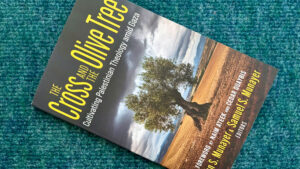
“The suffering of the innocent in the Holy Land has made all of us very uncomfortable. This Holy Week let’s not forget the Holy People of the Holy Land.” The words of Gerry Clarke SJ, director of the Belfast Jesuit Centre as their book club finished a seven-week discussion of The Cross and the Olive Tree: Cultivating Palestinian Theology Amid Gaza, which they began on Wednesday, 14 January.
The book is a compilation of seven essays by eight Christian Palestinian theologians, edited by John S. Munayer and Samuel S. Munayer and published by Orbis Books ». On the last night, the Zoom book club members were joined by the two Munayer brothers from Jerusalem, who discussed their final chapter, ‘Palestinian Theology of Martyrdom’ with them.
The two Christian theologians shared that, for them, the traditional understanding of martyrdom as dying for the faith has to be deconstructed in some respects and understood not just in terms of death but also of living and witnessing for Christ.
They write that a true Palestinian theology of martyrdom “is deeply rooted in faith, anchored in the conviction that true witness transcends both empire and death.” They say it draws its strength from the power of the slain lamb,” whose liberation is not dependent on force or might but on transformative and redemptive love.” And they say it is through suffering of this type of martydom “amid cruelty, injustice, and death, that we encounter the profound mystery of love, justice and mercy, as ultimately revealed in the crucified Messiah.”
In their Zoom talk, they posed the vexed question of Christian unity in this regard, asking how effective the Christian churches are as a community of witnesses, given that they are ecumenically split and sometimes hostile or unsupportive of one another.
On an interfaith basis, they raised the possibility of Muslim and Christian Palestinians coming together through a renewed and life-giving theology of martyrdom and witness. In their article they say, “A Palestinian theology of martyrdom challenges the theology of survival that prioritises preservation over witness.” And they quote the prayer of Rafiq Khoury in his book about Eastern Churches in the ‘Arab tent’, “Lord, if we want to be witnesses to the resurrection, let us not be guardians of relics and graves.”
Despite the ongoing killings and attempted decimation of their people, not just in Gaza but in the occupied territories, the brothers end their chapter on a note of true Christian hope. “Even as the future appears grim, we hold fast to the hope that our witness will endure,” they write, “resisting the allure of comfort and defying the empire’s oppressive logic by embracing our own crosses.” They finish by noting as their final word that the true power of martyrdom “lies not only in its testament to suffering but in its courageous declaration that life, truth, and liberation triumph even in the shadow of death.”
As noted on the book cover, The Cross and the Olive Tree traverses “the lived theology of grandmothers to traditions of scholarship, from ancient liturgies to contemporary resistance.” As the eight theologians seek to present “a crucial and vibrant perspective on liberation, reconciliations, and divine imagination,” the cross and the olive tree are their symbols of “unwavering hope… faith and homeland.”
The Belfast Jesuit Centre book club is currently reading and discussing I Want You To Be: The God of Love, by Tomáš Halík.