
Remembering a unique Jesuit/Protestant school
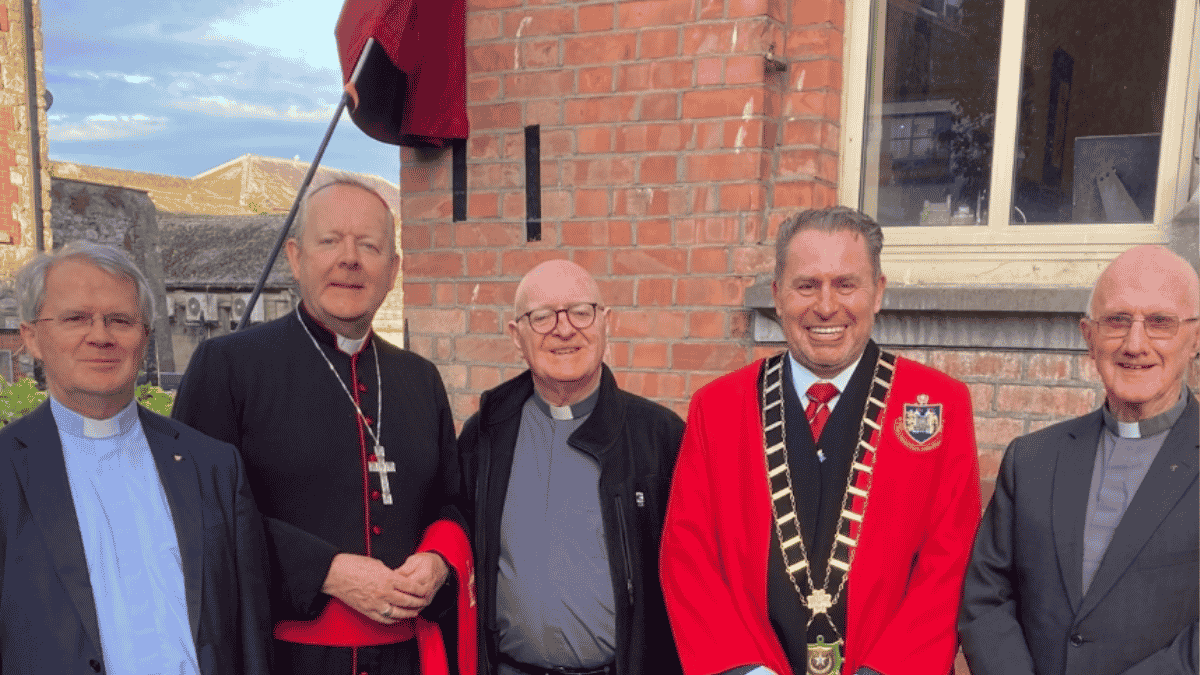
On Friday 3rd July 2026 a significant event took place in Drogheda to mark a short period in the history of the town, and the role the Jesuits had in that event.
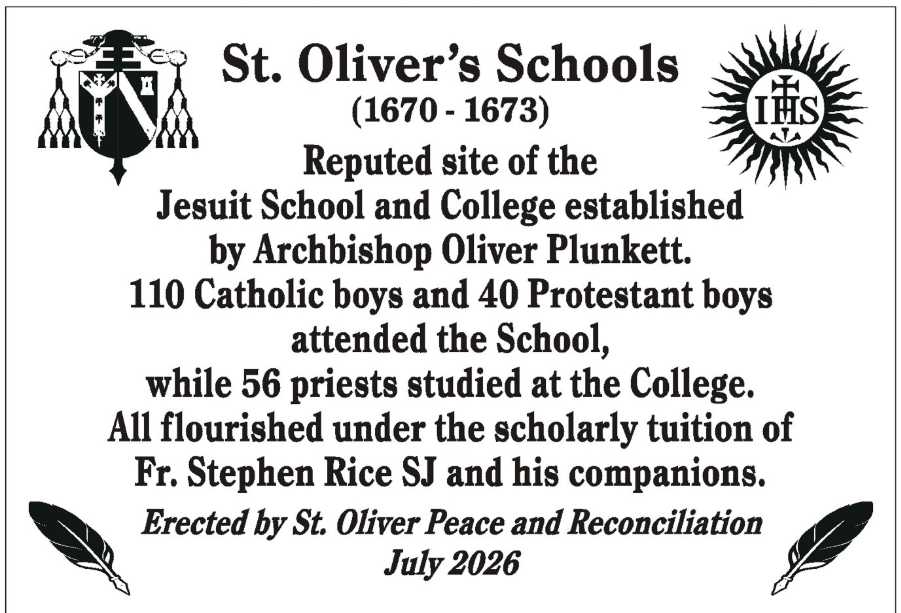
A plaque was unveiled by the Archbishop of Armagh, Eamon Martin, to mark the establishment by his own predecessor, Archbishop St Oliver Plunkett, of a school for boys and a college for priests in Drogheda in 1670. Oliver Plunkett, who had been studying, teaching, and living in Rome for about 20 years, was made Archbishop of Armagh in July 1669, and he returned to Ireland in early 1670.
Oliver had been in close contact with the Jesuits while he was in Rome and he was very aware of the extraordinary success that Jesuit education was having throughout Europe and the wider world. So, when he returned to Ireland and set about establishing the school and college in Drogheda, it was the Jesuits he asked to run them.
Three Jesuits taught in the school and college – Fr Stephen Rice, the superior, Fr Ignatius Browne, and Fr Murphy who was the only one of the three to speak, teach, and preach in the native Irish language.
Rigorous restrictions on Catholic life (including education) had been imposed by the Cromwellian military government. It was in 1670, during the more relaxed period after the restoration of King Charles II in 1660, that the Drogheda school and college began. However, those restrictions were to be imposed once again by the Dublin administration in late 1673 due to pressure against the Jesuits schools exerted on two viceroys – Lord Berkeley and the Earl of Essex, both supportive of Oliver Plunkett. As a result, the school and the college were forced to close after just 3 years and 5 months.
In the top left-hand corner of the plaque, the coat of arms combines the coats of arms of the Archdiocese of Armagh and the Plunkett family; in the top right-hand corner, the sunburst IHS of the Jesuit Order. As can be seen from the text on the plaque, there was a sizeable attendance, both Catholic and Protestant, at the school.
From the Catholic perspective, travel to the continent for schooling or for clerical training was prohibited. In addition, many Catholic gentry, who had been used to sending their sons to the continent for their education, had recently been dispossessed under the Cromwellian land settlement and were now unable to afford the costs involved. Within the Catholic community, the school and college were therefore much needed.
From the Protestant perspective, the excellence of the education offered by the Jesuits was already well known. This made the sending of Protestant boys to the Jesuit-run school a very attractive proposition, so much so that many families of the Protestant boys defended the school. The Jesuits operated the school and college free of charge.
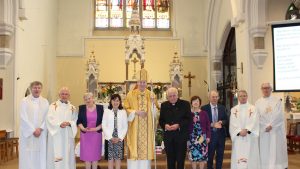
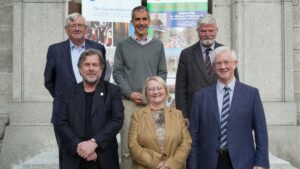
The photograph accompanying this story shows the unveiled plaque on the wall of the Augustinian Priory at Drogheda. The photo includes (left to right): Fr Leonard Moloney SJ, Fr Terry Howard SJ, Archbishop of Armagh Eamon Martin, Cllr. Declan Power, Mayor of Drogheda, and Fr Michael Sheil SJ. The Priory can be found in Batchelor’s Lane, behind the Augustinian Church on Shop Street. The Jesuit school and college is reckoned to have been located in the area currently occupied by the Augustinian Order.
The unveiling of the plaque was organised by Tomás Hodgins of the St Oliver Peace & Reconciliation committee, to whom the Jesuits are extremely grateful for making it possible to commemorate this short but significant moment in the history of Drogheda and the Jesuits. It was one of several events which took place on the weekend of July 3-5, 2026, marking the anniversary of St Oliver Plunkett’s death in 1681.