
Studies: ‘The Suffering of Innocents in War and Beyond’
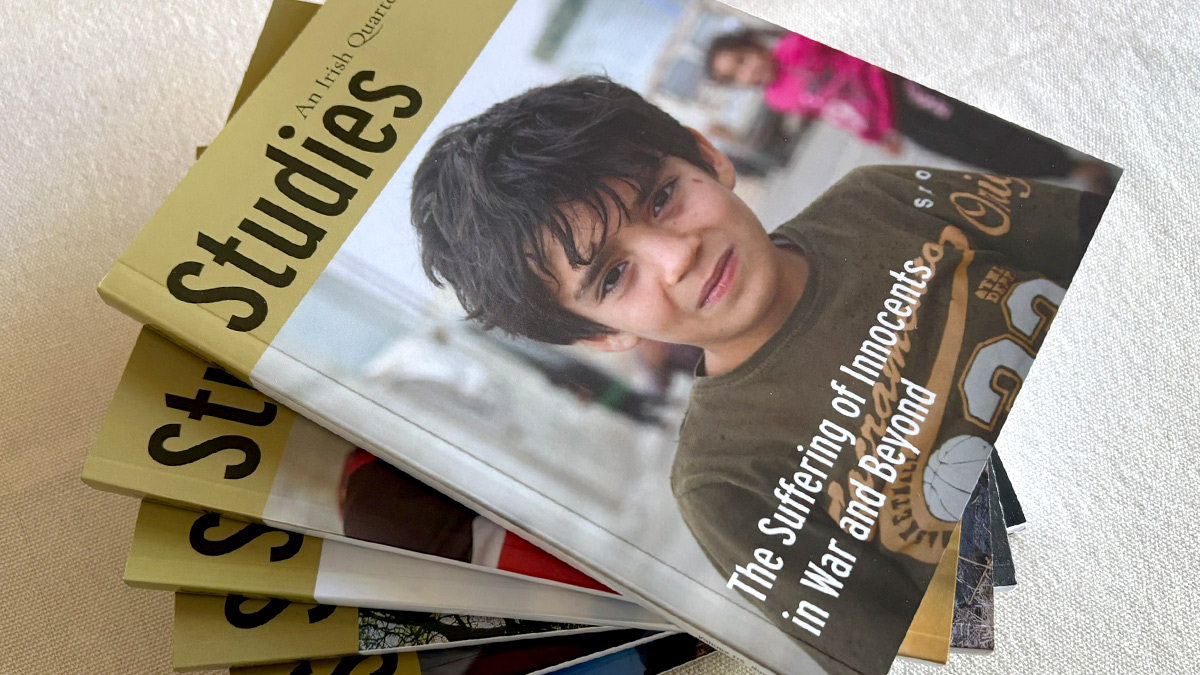
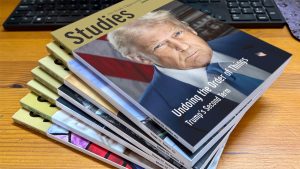
The summer issue of Studies: An Irish Quarterly Review responds to the current state of global affairs, in which, as Pope Leo has put it, “war is back in vogue and a zeal for war is spreading”. Present-day war invariably inflicts tremendous suffering on civilian populations, and not infrequently that appears to be the intention, not a side-effect. This issue of Studies also addresses other instances of suffering inflicted on innocent parties, beyond the theatre of war.
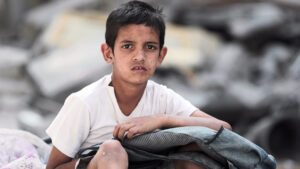
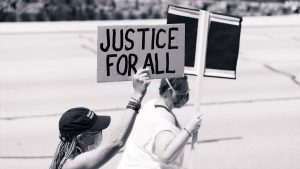
Perhaps the most appalling theatre of war in the world at present is the Gaza strip in Israel, where the Palestinian people have endured relentless genocidal destruction at the hands of the Israeli military. The most recent bout was triggered by Hamas murdering over 1,000 Israeli citizens on 7 October 2023 and taking around 250 hostages, but it must be remembered that Israel created the oppressive conditions in Gaza, beginning in 1948, and has sustained a particularly brutal assault on the territory since it withdrew its troops in 2005. In ‘Monopolising victimhood’, David Neuhaus SJ, who was himself born into a German-Jewish family in South Africa and has lived much of his life in Israel, rejects the exceptionalism of political Zionists who believe the state of Israel ought to be exempt from accountability and who refuse to extend to the Palestinians the recognition of victimhood that they claim for Israel itself. Neuhaus emphatically acknowledges that the Jewish people have suffered persecution of the worst kind down the centuries, culminating in the murder of millions by the Nazis in the Shoah, but he insists that ‘the fight against antisemitism and the fight for the freedom, equality, rights and dignity of Palestinians are both part of one and the same struggle: a struggle for a world free of injustice, racism and violence of any kind’.
In ‘The US-Israel war against Iran: The politicisation of religion’, James Kelly also addresses the situation in Gaza, as well as the related conflagrations in southern Lebanon and in Iran. He traces the way in which many of the belligerents in the Middle Eastern wars, including the Americans, call on religious history and prophecies and on images drawn from eschatological, messianic, and apocalyptic traditions, all as a way of legitimising their stance. It is a dangerous practice, he judges, and it contributes to the political and moral chaos that threatens to engulf us.
In Tobias Winright’s view, the ‘collapse of restraint’ in present-day wars that has led to high casualty rates among the most vulnerable civilians is an argument for reclaiming the just war moral tradition rather than abandoning it. In particular, he argues in ‘Just war and the vulnerable: Women and children’, it is essential that belligerents uphold the principle of noncombatant immunity.
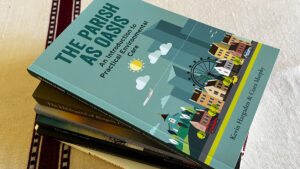
Wars can have victims far from the battlefield too. In ‘Secondary victims: Exploring collateral poverty and the Iranian energy shock’, Kevin Hargaden and Ciara Murphy draw attention to the devastating impact that the US-Iranian struggle to control the Strait of Hormuz is having on many Irish homes, leaving a great number of families vulnerable to fuel poverty. Ireland’s heavy reliance on fossil fuel energy is now exposed as a critical weakness, and the argument for a just transition to renewable energy has never been more persuasive.
In ‘History during wartime’, Neasa MacErlean notes the close connection between the study of history and the formation of perspectives that give rise to wars. Without rigorous and independent historical scholarship, nations are left vulnerable to the ‘war-justifying narratives’ of politicians and ideologues. She recounts the development of a more scientific and objective historical tradition in Ireland, in which her grandfather, Robert Dudley Edwards, played a decisive role, and she argues that it is a blame-free rather than value-free approach. As such, it has the ability to further greater mutual understanding between nations and even to prevent wars.
The failure to pay close attention to concrete instances of human suffering is not limited to war scenarios, of course. When one forms one’s understanding and takes one’s guidance from a grand narrative or a conceptual whole, it may happen that the experience, especially the suffering, of this or that person is overlooked – inattentively reduced to its place in the scheme of things. According to Dermot Roantree in ‘Suffer the little children: The fate of unbaptised infants’, this happened in Christian theology in relation to infants who died before they could be baptised. The normative weight of tradition, narrowly understood, kept the Church from responding appropriately to pastoral experience and the grief of parents until quite recently.
In his poem ‘The blood of the children is crying to me from the earth’, John F. Deane also calls to mind the unbaptised infants forbidden burial in consecrated ground and so buried instead in a cillín – a marginal ‘place of sorrow’ where they lie ‘lorn and unnamed’. He brings this image together with another excruciating image of suffering and sorrow, the murdered infants of the genocide in Gaza – ‘innocence wrapped in small packages of the whitest linen’. The poem finishes with a prayer that the ‘plea for justice’ would be heard by ‘the One, the All,/ that you stay close to us in our coming in, in our going out’.
Another failure to extend due care to sufferers is the subject of Keith Adams’s essay, ‘Beyond binaries: The psychiatric prisoner as victim’. He notes that there is a growing number of ‘mentally disordered offenders’ in Irish prisons, and that the prison system does not cater at all adequately for people with severe mental illness. The Irish government is ‘more content to punish people with psychiatric illness than to care for them’, Adams argues, adding that many prisoners with psychiatric illness are victims who are exposed to further victimisation.
In the next section of this issue of Studies, there are essays relating to Irish literature, history, and public policy. Breffni Martin provides a short biography of his father, Augustine Martin, academic, senator, and editor of the Leaving Cert poetry anthology Soundings, well known to school-goers in the last decades of the 20th century. Kevin Whelan traces the tension in the Irish Church as English ecclesial forms were introduced into Ireland after the Norman conquest, and he follows the developments that led to the Gaelic system being superseded in the days of the Counter-Reformation by Roman and anglicised forms. In ‘Waking James Joyce: A Dublin vignette’, Thomas O’Grady provides an insight into how James Joyce was seen by other writers and artists in Dublin, by following the stories of a small group that gathered in an art emporium in 1941, when the discussion turned to Joyce.
In 2024 and 2025, Cambridge University Press published two of the Gospels, John and Matthew, richly illuminated by calligrapher Jane Sullivan. Sullivan is interviewed here by Susanne Jennings, in ‘“When you write very, very slowly, the song of the letters hums in the silence”: An interview with Jane Sullivan, calligrapher’. In ‘Where now for Citizens’ Assemblies?’, Edmond Grace SJ explains the history and the rationale behind the various structures designed to enrich deliberative democracy by increasing citizen participation as a way of addressing a decline of public trust in government.
Finally, in ‘Concentrated wealth: How the “greatest of plagues” has deeply infected global politics’, a review article that covers three books concerned with economic and power inequalities in the contemporary world, Peadar Kirby connects wealth inequality with the obsession with ‘endless production’ and with nationalism, leaving us, as Pope Leo has surmised, ‘in deep trouble’. Kirby finishes with Pope Francis’s judgement in Fratelli Tutti that ‘inequality and lack of integral human development make peace impossible’.
The volume finishes off with a few book reviews. Irish poet Tom McCarthy reviews two books of poetry together, one by John F. Deane and the other by James Harpur. And two further books of poetry are also reviewed, again by a poet. Ciarán O’Rourke reviews poetry by Paddy Bushe and Gerard Smyth. And finally, Gerry O’Hanlon SJ reviews Bishop Brendan Leahy’s book, What God expects of the Church: Recent Experience, Theology and Spirituality of Synodality.