
Art as prayer: Evie Hone and the Ignatian vision
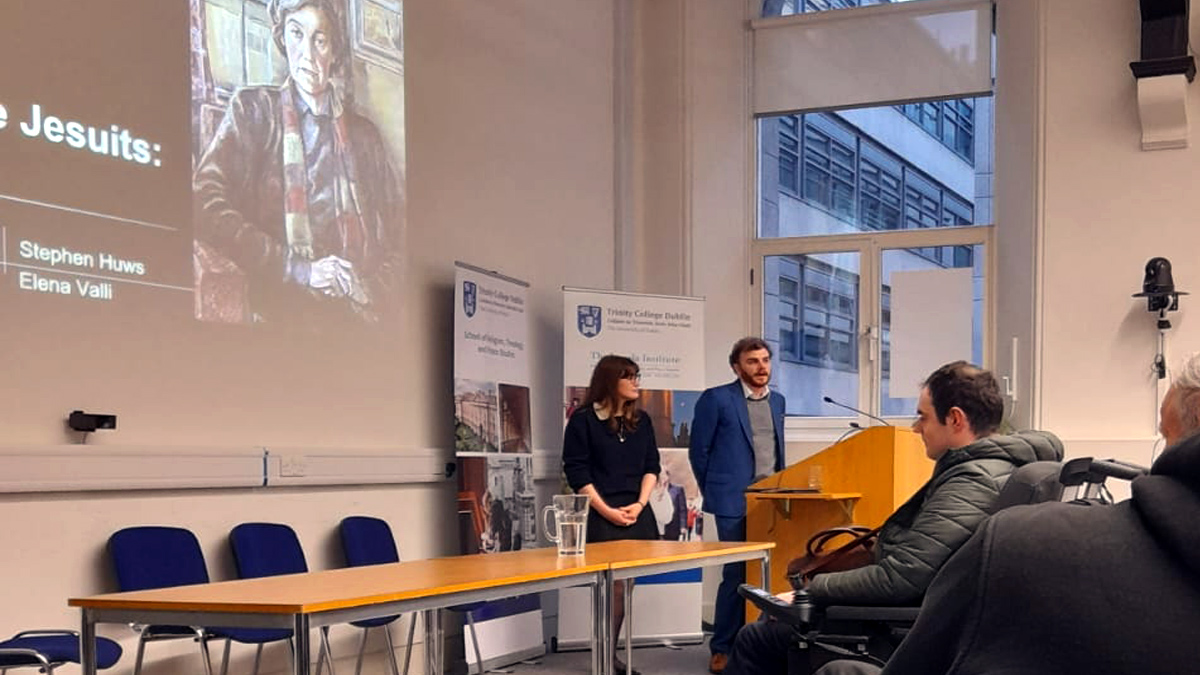
On Thursday, 16 June 2026, the Loyola Institute at Trinity College Dublin hosted an illuminating lecture exploring the profound intersections between modern Irish art, patronage, and Ignatian spirituality. The talk, entitled ‘Evie Hone and the Jesuits: An Exercise in Spirit’, was presented by Stephen Huws and co-written with Elena Valli, both recent doctoral graduates from Trinity College Dublin.
Dr Huws, who completed his PhD in the School of Religion, Theology, and Peace Studies on the reception of the Virgin Mary in Irish stained glass, collaborated with Dr Valli, whose doctoral research in the School of English focused on late twentieth-century poetry and its intersections with Catholic and Ignatian meditation. Together, they offered a striking new framework for evaluating the sacred legacy of one of Ireland’s greatest twentieth-century artists, Evie Hone.
The lecture opened by charting the early life of Hone, highlighting how her early suffering, religious devotion, and dedication to art would eventually find their fullest expression in her stained-glass work — the public manifestation of a profound and deeply interior spiritual life. Her Cubist training in Paris gave her a mastery of geometric form and colour that translated naturally into leaded glass. In contrast to her famous contemporary Harry Clarke, whose figures are often lithe and haunted, Hone developed a visual language that was solid, weighty, and deeply contemplative. By utilising large pieces of glass, thick paint, and expressionistic outlines, her work achieved an unmistakable sense of monumentality and spiritual gravity.
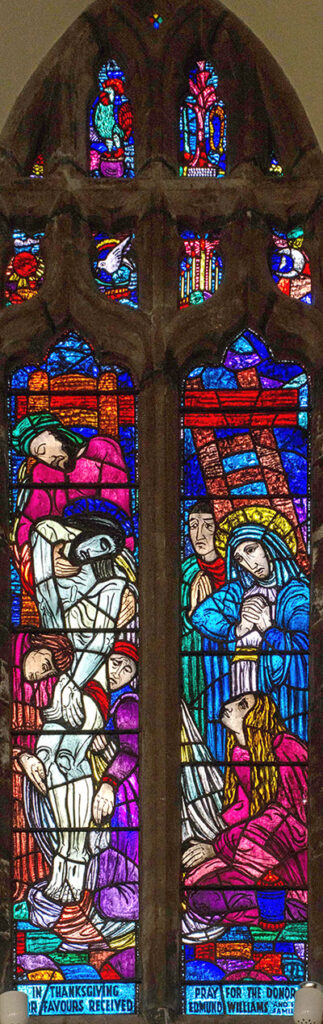
Another powerful example highlighted by the speakers was her windows in the Seven Dolours sequence for Clongowes Wood College. In the Sixth Dolour, Hone brilliantly integrated the chapel’s physical architecture into the biblical event by using the window’s central stone mullion to form the vertical beam of Christ’s Cross. This effectively blurred the boundary between the historical gospel scene and the physical space inhabited by the viewer, who is transported into the scene.
The core of the presentation argued that Hone’s extensive commissions for Jesuit communities — comprising twenty-five works — reveal an enduring spiritual affinity between the artist and the Ignatian tradition. Dr Huws and Dr Valli proposed that Hone’s windows can be understood as visualisations of the meditative techniques found in the Spiritual Exercises of Ignatius of Loyola. In these exercises, St Ignatius instructs the meditator to engage vividly with sensory imagination and to place themselves actively within the Gospel scenes under contemplation. The speakers demonstrated how Hone mirrors this methodology in her designs. In her Nativity window for St Stanislaus College, for example, a single, downscaled shepherd stands apart from the Holy Family, embodying the role of the detached yet prayerful observer encouraged in Ignatian contemplation
The lecture concluded by showing how Jesuit engagement with Hone’s art continues to the present day. Following the closure of St Stanislaus College, the windows were reinstalled in 1992 at the Manresa retreat house in Dollymount, where they continue to attract retreatants and visitors who contemplate them in the Evie Hone Room. At the opening of the installation, former Superior General of the Jesuits Peter Hans Kolvenbach beautifully observed that through these masterpieces, “art becomes prayer”. The lecture was exceptionally well received and prompted an energetic post-talk discussion, demonstrating that Hone’s windows continue to function as vibrant instruments of active contemplation and spiritual reflection.
You can contact Dr Huws by email here: [email protected]. And Dr Vallie by email here: [email protected]