
‘Faithful Justice Today’

What should ‘faithful justice today’ look like?
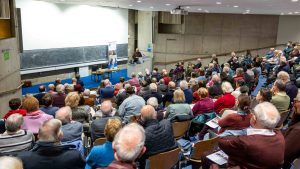
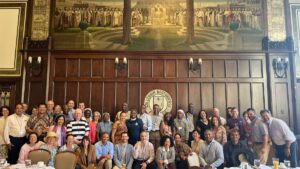
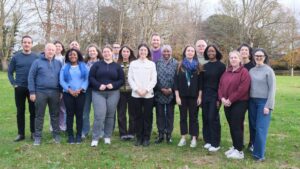
This was the thematic question explored on Saturday 15 November 2025 at a one day gathering organised jointly by the Jesuit Centre for Faith and Justice and the Loyola Institute TCD. The event, entitled ‘Faithful Justice Today: A Renewed Call to Action,’ had over 60 participants, including laypeople, religious, clergy and bishops.
There were six speakers and, after the input from paired speakers. participants were invited to form small groups in which they could share their reactions to what they had heard. This was done along the lines of the ‘conversation in the spirit’ method. This entailed listening to each group member without interruption or comment as they shared on a moment of light and of shadow that struck them.
Group feedback was shared in three plenaries along with the feedback from a final group session in which participants were asked to share on what they thought were the major themes overall, that had emerged for attention.
Julieann Moran, general secretary of the Synodal Pathway for the Catholic Church in Ireland, facilitated proceedings, summarising the feedback from participants after each session. Papers from the conference will be published in the spring edition of the Jesuit journal Studies ».
After a warm welcome to all from Jesuit Socius Terry Howard SJ on behalf of Irish Jesuit Provincial Shane Daly SJ, theologian Gerry O’Hanlon took to the floor to give the first input. In his talk on ‘The Struggle for Justice and Synodality,’ he set out the context of the origin and significance of the turn taken by the Jesuit Order in 1974/75 toward a ‘faith that does justice,’ and how it is connected to the synodal process initiated by Pope Francis, that the church is engaged in today.
Dr Michael Kirwan SJ (Loyola Institute) spoke of the challenges in developing a political theology as part of the justice and faith agenda, while Professor Marie Keenan (formerly UCD) addressed the vexed issue of sexual abuse in society and within the Catholic church. She posed the equally vexing question, “Is this the place where people of faith do justice (differently)?”
The place of women in the church, and wider society in general, was explored by theologian Dr Suzanne Mulligan (Notre Dame University) – an issue echoed in other speakers’ input as well as from the floor. Dr Anupama Ranawana (Durham University), noted the link between the current climate crisis and gender based violence, in her address on the place of ‘care for the earth’ and faith based justice.
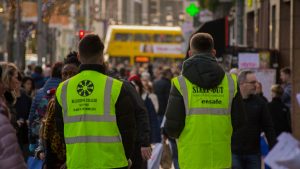
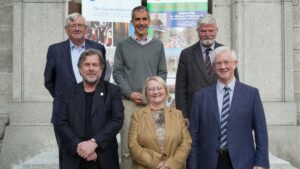
Dr Kevin Hargaden (JCFJ), proposed that enacting a faith that does justice today will be most fruitful if done in partnership with other justice seeking groups whether faith based on not. “The Spirit builds partnerships if only we have the eyes to see it,” he said.(See photo)
Three abiding images from the event helped participants discern the overall themes that stood out for them over the course of proceedings. The ‘bent over’ woman from Luke’s Gospel (referenced by Suzanne Mulligan) who managed to interrupt the ‘status quo’ gathered around Jesus, and drawing recognition and healing from Him; the ‘broken body’ not just of victims of poverty and violence but of the earth itself (thus Gaza is not just a place of genocide but of ecocide – Anupama Ranawana). The broken body of creation and its creatures mirrors the broken, vulnerable body of the crucified Christ; and the dance of the Trinity (perichoresis) that we are all invited to join, remembering, if we have forgotten, that a faith that does justice is not our mission but God’s mission (the Missio Dei) that we are called to be part of. “God’s mission has a Church – not the other way around”. (Kevin Hargaden).
There was plenty of realism about the ‘polycrisis’ facing people of faith who want to do justice today. Those many crises can evoke a ‘terrafurie’ – a lament of grief and despair. Three quarters of the world’s starving millions are women and children. But the ‘lens of rage’ can be a powerful tool, people were told, provided they do not become like the unjust whom they are challenging. As Michael Kirwan noted, fighting for justice can create conflict which entails the risk of those ‘on the side of right’ becoming the mirror image of the people, and the injustice, they are fighting against. “We need something of St Ignatius’ Annotation 22″ he said », ” if we are to lower the political temperature and move beyond … the black and the white, right versus wrong” trap that threatens to ensnare those who would embrace a faith that does justice.
And there were plenty of questions: What must be done to heal creation’s bleeding wounds? (L. Boff) Who should we never go into partnership with? How do we deal with Christian nationalists? Where are the women’s’ voices? What are their stories? Are we in the midst of a new awakening? Can we construct a doctrine for this new and unfamiliar landscape?
There was also a real sense of Christian hope. “Something new is afoot”, (theologian Elizabeth Johnson); “We are at a hugely significant moment in the history of the church;” “Synodality is a more official way of authentically becoming the reform that is needed in the prevailing ecclesial culture;” “Women are reclaiming their agency in a myriad of ways today;
Theologian Philip Moller SJ, who gave the final reflective input of the day, reminded those who might balk at the task facing them, that the ‘missio dei’ Christians are called to join in, is in cooperation with the risen Jesus. His resurrection assures us He/we will not fail as we draw on His risen power. We have to recover the experience of the people of God as expressed through the history of theology, Moller continued. This will help us, along with the resources of Catholic Social Teaching, which offers those seeking justice a true vision of human dignity, and a nudge to bear patiently and ‘take the long view’.
Fittingly the day concluded with a moving commemoration of the martyrs of UCA in El Salvador – six Jesuits along with their housekeeper and her daughter who were gunned down on 16 November 1989 by the Salvadorian army ». And of Kenyan Jesuit Fr Victor Luke Odhiambo SJ, who was murdered in South Sudan on the night of 14 November 2018 ».