
A Century of Working Notes
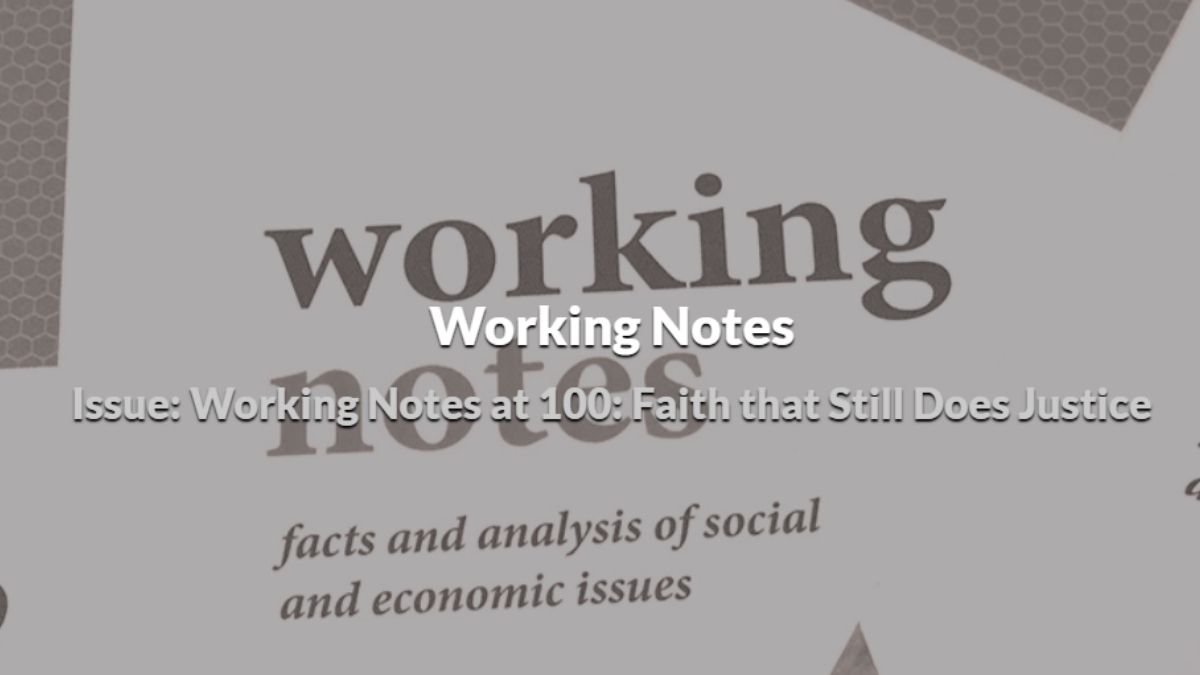
“Working Notes continues to be a flagship expression of the Irish Jesuits’ commitment to both the sacred and the secular sciences, and their mutually enriching collaboration.” So says Niall Leahy SJ, current director of the Jesuit Centre for Faith and Justice » and editor of its quarterly publication, which marks its 100th issue this year ». It does so with a renewed commitment to integrating theological insight and social science to address Ireland’s pressing problems.
The journal is rooted in a 1975 Jesuit decree that framed the Society’s mission as “service of faith” tied inseparably to “the promotion of justice,” and evolved from a modest publication focused on 1980s unemployment to a platform for policy-driven reflection on contemporary social crises.
This milestone issue features a series of manifesto-style contributions from the centre’s policy advocates, each outlining concrete priorities and proposals informed by the Jesuit tradition of rigorous social analysis. It seeks to bring sacred and secular disciplines into productive dialogue so theology can contribute constructively to public life.
The collection opens with Dr. Kevin Hargaden’s call for a public-facing social theology. Hargaden argues that cultural individualism — pervasive even among Christians — has frayed communal instincts, leaving space for populist and tribalist responses. He urges theology to work with secular sciences to shape policy that protects human dignity and the common good, citing local research such as ‘Faith in the North-East Inner-City’ as evidence that faith-informed public engagement can be both credible and constructive.
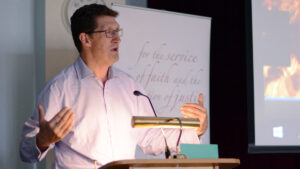
Dr Hargaden, a former director of the JCFJ, is leaving the centre to take up a post at Notre Dame University, USA, this summer. He will deliver a farewell lecture on Wednesday 29 July 2026, in which he will reflect on the potential of social theology, touching on the core themes that have shaped recent theology here in Ireland. These include the abuse crisis, the role of the church in wider society, and the relationship of theology to other intellectual disciplines. (John Sullivan Room, Gardiner St Church, Dublin 1, 7pm.)
Criminal justice receives urgent attention from Keith Adams, who warns that Ireland’s prison population is climbing toward 6,000 and that the expansion of prison capacity would be costly and counterproductive. He proposes four practical steps toward penal minimalism: independent investigative mechanisms, halting new prison construction, setting a firm cap on total prison places, and closing female-specific prison facilities. His essay frames prison reduction not only as fiscal prudence but as a moral necessity.
Housing and homelessness are spotlighted by Dr. Alexia O’Brien, who challenges official narratives by distinguishing multiple, overlapping housing crises. She highlights “hidden homelessness” — people not captured in emergency accommodation statistics — and cites local examples, such as Gardiner St Primary School SJ, where one in five pupils are homeless or in emergency housing. O’Brien looks to European models for both better measurement and more humane affordable housing policies.
Environmental and food-system vulnerabilities are explored by Dr. Ciara Murphy, prompted by recent fuel-price protests. Murphy identifies Ireland’s dependence on private cars and imported fertilizers and food as structural weaknesses. She champions child-centred urban planning to reduce car dependency and supports agroecology movements that re-localize food production, strengthen ecosystems, and build resilient communities.
The issue closes with a personal perspective from Sophie Manaeva, a theological research assistant pursuing an MPhil in Theology and Social Justice. Her work with The Bohemian Cooperatives exemplifies a new generation answering Pope Francis’ call to “build an economy with a soul,” blending faith-driven ethics with grassroots economic practice.
Across these essays, Working Notes reaffirms its founding mission: social analysis informed by a moral theology that seeks reconciliation and the common good. This centennial issue marks the journal’s continuing civic contribution, offering tangible proposals to shape Ireland’s social and policy conversations.