
Overwhelming kindness, generosity, faith
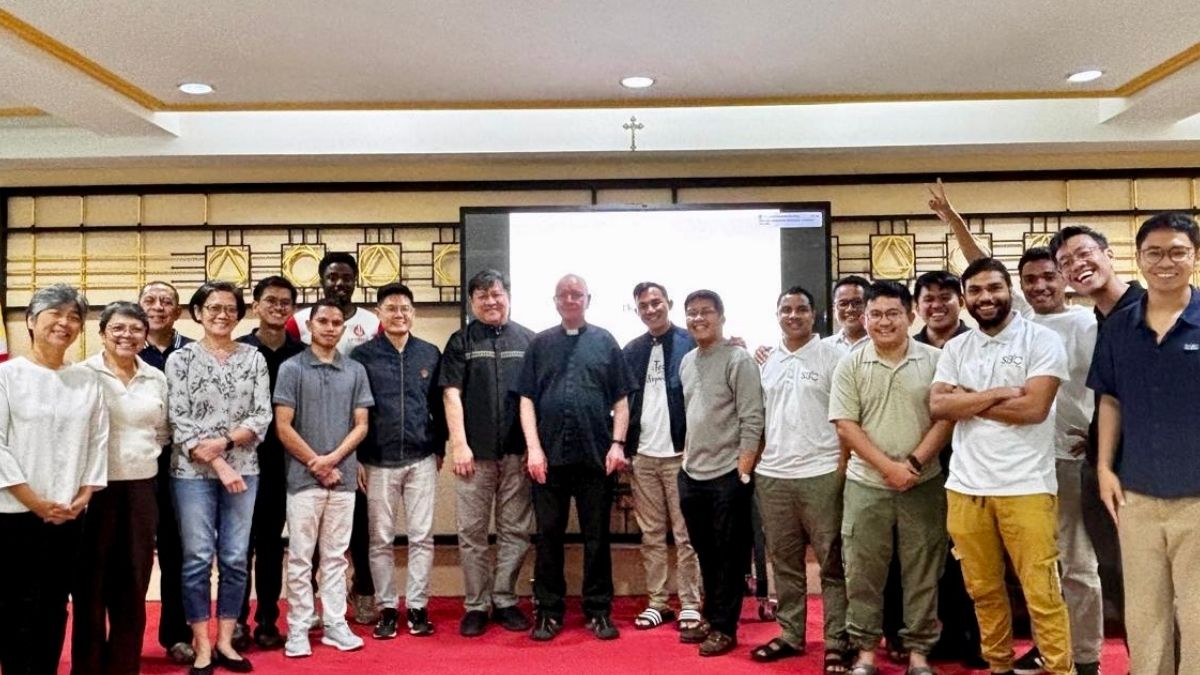
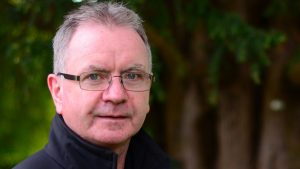
Brendan McManus SJ recently returned from Manila, where he gave talks and led retreats. Reflecting on his visit, he remarked: “Even though I was ostensibly there to give some talks and retreats, I received far more in return. I was met with overwhelming kindness, generosity, faith, and great humanity.”
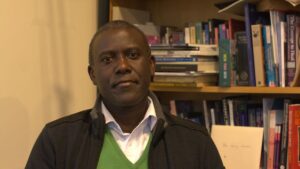
Among the many encounters that marked his time there, one stood out in a particular way. Brendan recalls how a local woman, Cory Villafania, left a profound and lasting impression on him. Having lost two sons in tragic circumstances, she spoke with remarkable honesty and composure about the depth of her grief and the faith that sustained her through it. Rooted in the conviction that God does not stand distant from suffering but enters into it, her story reveals how consolation is first received and, in time, offered to others. What unfolds is not a simple narrative of recovery, but a deeply human account of love, heartbreak, forgiveness, and the slow, grace-filled emergence of healing.
Brendans reflection and Cory’s full testimony can be read below.
Reflection on the Philippines: One Woman’s Extraordinary Faith Story
Brendan McManus SJ :: It is with profound gratitude that I remember my visit to Manila in February/March 2026. Even though I was ostensibly there to give some talks and retreats, I received a lot more. I was met with overwhelming kindness, generosity, faith, and great humanity. I loved being there—meeting people, having conversations, and seeing the place. It was so vibrantly alive, and faith was so visible and tangible there, in the heart of Asia. Despite the problems facing the country, they have stayed resilient, open, welcoming, and generous.
Fortunately, most people spoke English, which they learn in school, and almost all signs and instructions were in English too. Of course, they were under American rule for almost half a century and also have their own language, Tagalog. This was initially strange to see in Asia, but it certainly helped a lot and meant that I could operate in that language for my talks and retreats without translation. It also meant we had some very meaningful conversations, sharings, and question-and-answer sessions that I appreciated. I found the people unfailingly warm and friendly and loved being there on the other side of the world.
There has been a huge Spanish influence in the Philippines, of course, with years of colonisation (1565–1898). Most of the older churches I visited were in the Spanish Baroque style, though extra robust due to frequent earthquakes. What was confusing was that, despite having typical Spanish names, virtually no one spoke Spanish! However, it has shaped the Catholic faith there, with many of the devotions—especially the Holy Week processional images—very reminiscent of Spain. There is a particular fascination with the bloodied, suffering Christ that I also saw in Colombia.
People were everywhere, and life pulsed through the place. It was colourful and vibrant; there was poverty, and the poor were evident, but great wealth also. There was a lot of traffic congestion and yet extraordinary patience in the middle of chaos. There were few traffic lights or lanes, and drivers simply pulled out, knowing that people would let them in with great tolerance. Pedestrians likewise walked across anywhere and flagged drivers down to get across; even pedestrian crossings were optional and at the discretion of drivers. Motorbikes were everywhere and weaved in and out through traffic—the most efficient way to get through a congested city. So, the transport services had evolved: motorbikes offer passenger services. Just like a taxi or an Uber, you book on the app, get picked up, are given a helmet, and sit on the back of the bike. One such service was called ‘Joy Ride’, without realising what the words actually meant, I suspect!
Another story that stayed with me: a taxi driver, during the journey, asked me my age. When I told him, he commented that I was in good shape for my age, since many Filipino men don’t have a long life expectancy. This was another surprise for me—just one of the things we take for granted in the West.
What really stayed with me, though, was a personal faith testament I heard from a local woman named Cory Villafania. She gave me permission to use her notes and told me to circulate her story, which you can read below. We co-presented a retreat on grief for CLC Philippines, and very quickly I realised I was in the presence of someone special. Her testimony reflected a deeply personal journey through grief, loss, and healing, grounded in faith in a compassionate God who consoles and accompanies. Initially, she quoted 2 Corinthians 1:3–5: “God comforts us in all our afflictions, so that we may be able to comfort those in any affliction…” She described suffering as a shared human experience through which God offers comfort—not only for oneself but so that one may, in turn, comfort others. Little did I realise what was coming…
In a very composed and calm way, she told her story about the deaths of two sons. The first, JB, lived with an intellectual disability and later suffered from acute renal failure. His illness, which featured violent episodes, brought immense physical and emotional strain to the family, particularly to his father, Nelson, who devoted years to caring for him with patience and tenderness. Despite JB’s suffering and moments of distress, the family also witnessed profound love, particularly in Nelson’s ability to hold his son even during violent outbursts. JB’s eventual death in 2004 plunged the family into grief, with Nelson experiencing deep depression. Yet a simple line JB had on his favourite T-shirt—“God is good all the time”—became a refrain and inspiration toward acceptance and healing.
Incredibly, some years later, tragedy struck again when their other son, NJ, died in a road accident caused by a negligent bus driver distracted by his phone. The shock, anger, and desire for justice were intense, particularly as the system allows for a personal confrontation with the accused. Nelson initially struggled but chose forgiveness, even confronting the driver with a call to change his life rather than seeking revenge. Cory herself found forgiveness more difficult, but in a moment of grace during a mediation meeting, she unexpectedly found herself extending forgiveness to the driver. This marked a profound shift in her, leading even to compassionate gestures toward him, even buying breakfast for him, while still upholding justice through the legal process.
Throughout both tragedies, Cory emphasised God’s presence through prayer, scripture, the Eucharist, and supportive relationships. She concluded that healing comes not only from being comforted by God but from sharing one’s story, facilitating others in finding hope, meaning, and new life even amid suffering.
“God is good all of the time!”
Last 21 January, 2026, after I had participated in the Eucharist in honour of St Agnes, Virgin and Martyr, I prayed Lauds, and I was struck by this reading from 2 Corinthians 1:3–5:
“Blessed be the God and Father of our Lord Jesus Christ, the Father of mercies and the God of all consolation! He comforts us in all our afflictions, so that we may be able to comfort those in any affliction with the comfort with which we ourselves are comforted by God. As we have shared much in the sufferings of Christ, so through Christ we share abundantly in His consolation.”
I believe that this passage captures the essence of what I would like to share with you today: that as we go through our pilgrimage here on earth and experience grief or pain, loss, suffering, or any kind of brokenness, our Lord of mercies comforts us with His loving presence. He comes through moments of prayer, through His Word and the Eucharist, through a phrase uttered in casual conversation, or events that are more than coincidences. He comes through people who listen and accompany us in our grief or loss—not by speaking many words, but by walking with us with tenderness and compassion. They offer a healing presence.
I realise now that our common journey is a journey of the wounded, the broken, the grieving, who are called to share not only what we have been through but, more importantly, how the Healer God has entered into our chaos, comforted us, and brought us new life.
On 26 January , 2004, we lost our eldest son, JB, to acute renal failure. Before that, he had been diagnosed with mild intellectual disability, which was confirmed medically when he graduated from grade school. We tried to enroll him in one or two special schools, but he didn’t last. My husband Nelson made a very difficult decision—early retirement in 1997—just so he could be with JB, because no helper lasted either, especially due to JB’s tantrums. I continued teaching, as there were four other children who depended on us.
Even if Nelson was oftentimes the victim of JB’s uncontrolled outbursts, despite medication and regular visits to the psychiatrist, Nelson treasured those seven years with our son. In 2003, JB began vomiting continuously and was hospitalised. After many tests, he was found to be suffering from acute renal failure. Mild intellectual disability and acute renal failure were not an easy combination to deal with. When JB could not urinate and could not bear the pain, he would go into tantrums. When Nelson tried to pacify him, they would roll on the floor, and JB would hit his father again and again—but Nelson would just embrace him.
Much as I wanted to separate them—I was already shouting and crying at the same time—I couldn’t, because JB was bigger and stronger than his father. Not minding the hurt, Nelson continued to embrace JB until he calmed down. And when he did calm down and realised what he had done, he cried and said “sorry” to his father. And we cried together.
There was also a time when JB could not sleep until the early hours of the morning. We stayed awake with him, and he kept saying, “Gusto kong lumabas!” (I want to go out). That was around one or two in the morning. So Nelson and I helped him into the van, and we went to Calamba town proper and drove around, hoping it would help him fall asleep. Eventually, after an hour or two, he did fall asleep. We let him stay in the van because that was one of the few times he could rest.
We prayed a lot for JB’s recovery and tried all medical possibilities, even when we were told that only 10% of his kidneys were functioning. One doctor said that only dialysis or a kidney transplant could help him. We were going to try dialysis, even if it was very expensive, but another doctor, a good friend, discouraged us. She said JB might not understand the process and might pull out the fistula from his arm, which could create even greater chaos.
Our second son, Mitch, even wanted to donate one of his kidneys, but again our doctor friend said, “God did not give us two kidneys for one of these to be given away.” Thus, JB survived a little longer with the help of painkillers, but at times he would still bang his head against the wall because he could not urinate. I was sleeping beside him one night, and he would get up every five minutes to go to the bathroom, only to be frustrated again and again. I suffered seeing him suffer.
I tried to comfort him, to embrace him, to tell him “I love you,” but it all felt futile because he was in deep pain. I prayed to Mary and asked for her help: “Blessed Mother, please help my son. Help me, for I do not know how to be a mother to a dying boy…”
Despite all this, JB was faithful to Sunday Mass. The Mass was at 6 p.m., but JB, already sick and weak, would be dressed by 3 p.m. One time during Mass, JB almost fell because he felt weak, so we told him to stay in the car and rest. He replied with determination: “Hindi, Mama. Tatapusin ko ito…” (No, Mama. I will finish the Mass.) And he stayed until the end.
On 26 January, 2004, JB went home to the Father. He was the first child we lost, and it was not easy—especially for Nelson, who had taken care of him for the last seven years of his life. He did not want JB’s room touched (except for cleaning) for two years because he could not accept that the boy he played softball with, went to the movies with, and shared happy moments with was gone. Nelson fell into depression.
I had to deal with my own grief, but I was also being invited to accompany my husband in his grieving, and then to return to teaching. We had four other children, after all. Then, after two years, Nelson felt moved to go back into JB’s room and found one of his T-shirts that said, “God is good all the time!” This became his invitation to accept JB’s death and begin to let go.
In 2011, our fourth son, Nelson Joseph Jr., or NJ, became very sick and was confined in Makati Medical Center for about a week. He was diagnosed with pneumonia. I was with him throughout his illness, and it was one beautiful week of simply being together. I do not remember many details except that we talked deeply, we laughed together, we prayed and hoped together. NJ hardly complained. All I heard from him was, “Thank you, Mama.”
A few weeks or months after NJ’s recovery, he was run over by a jeepney driver who was distracted by his cellphone. He died in the early morning of June 26, 2011, but we only found him later that evening in a funeral parlour because he had left his ID at his boarding house. According to a witness, he was still alive after being hit, but no one dared to bring him to the hospital, perhaps out of fear. He was eventually taken there, but he died.
I was numb. I could not cry, even when I saw NJ’s body in the coffin. I saw only his closed eyes, surrounded by dried blood. Our son Mitch, who is a doctor, looked further and said, “Broken ribs and broken legs. Do you want to see, Mama?” “No,” I said. “What for?” I did not know what to feel. All that came to me was this: only a short time before, NJ and I had shared such love, even in his illness—and now this.
The next day, Nelson had to attend the inquest so that charges could be filed. The warden told him that he would hand over the driver to him for ten minutes so that he could do as he wished—implying revenge. Nelson was praying intensely because it was a strong temptation. He knew he could not yet forgive; he was filled with anger. But he continued to pray.
When the driver was brought before him, and the warden expected him to strike the man, Nelson instead said: “Do you know what you did to my son? You killed him! Please change your life.” And without harming him, he returned the driver to the warden.
During NJ’s wake, some co-workers came and said, “We were with him only one day, but we already experienced his goodness. He even fed us and gave us money for transport.” This was a real consolation for us.
At NJ’s funeral Mass, after the eulogy, Nelson declared, “Today, I forgive the driver who killed our son.” When I heard that, something in me resisted and said, “Not me.”
Charges were filed, and I later joined Nelson at the hearings because I wanted justice. During a mediation meeting, I faced the driver and said, “From the beginning until now, you have not even asked for forgiveness.” He replied, “I wanted to, but I was afraid you would say, ‘What is the use? Your apology cannot bring him back.’”
Then I heard myself say, “Why don’t you try?” He apologised to Nelson, then to me. And after he spoke, something—or Someone—moved me. I reached out, held his hand, and said, “I forgive you.” And we both cried.
What happened after that can only be attributed to the grace of God. As we continued attending the hearings, we would ask if he had eaten, and if not, we would buy him food. The relationship had changed. We knew in our hearts that God was accompanying us, helping us move beyond anger toward true forgiveness. At the same time, we made it clear that he still had to face the consequences of his actions. He understood, and when he was eventually sentenced, he accepted it calmly.
Through these two painful events, the Lord accompanied us in many ways—through people who stayed close, especially my mother, who reminded us: “Your children are not yours but God’s. He entrusted them to you. When their mission is complete, return them to Him with open hearts.”
God’s presence was also felt through prayer, through His word, and most especially through the Eucharist. Healing came as we came to see more deeply the kind of persons JB and NJ had become—young men who loved God and who cared for others in their own way. As JB’s T-shirt reminds us: “God is good all the time.”
As the Lord has walked with us in our grief and loss, healing continues as we share our story with others. In telling of the death of our two sons and the grace of forgiveness we received, others too begin to discover meaning, hope, and new life. Together, we experience the new life promised to those who trust in Him.
Praise God.
Cory O. Villafania,
Talk at the CLC retreat, Mary Queen Church, Manila,
28 February 2026.

Photo taken by Brendan McManus