
René Girard and J.D. Vance
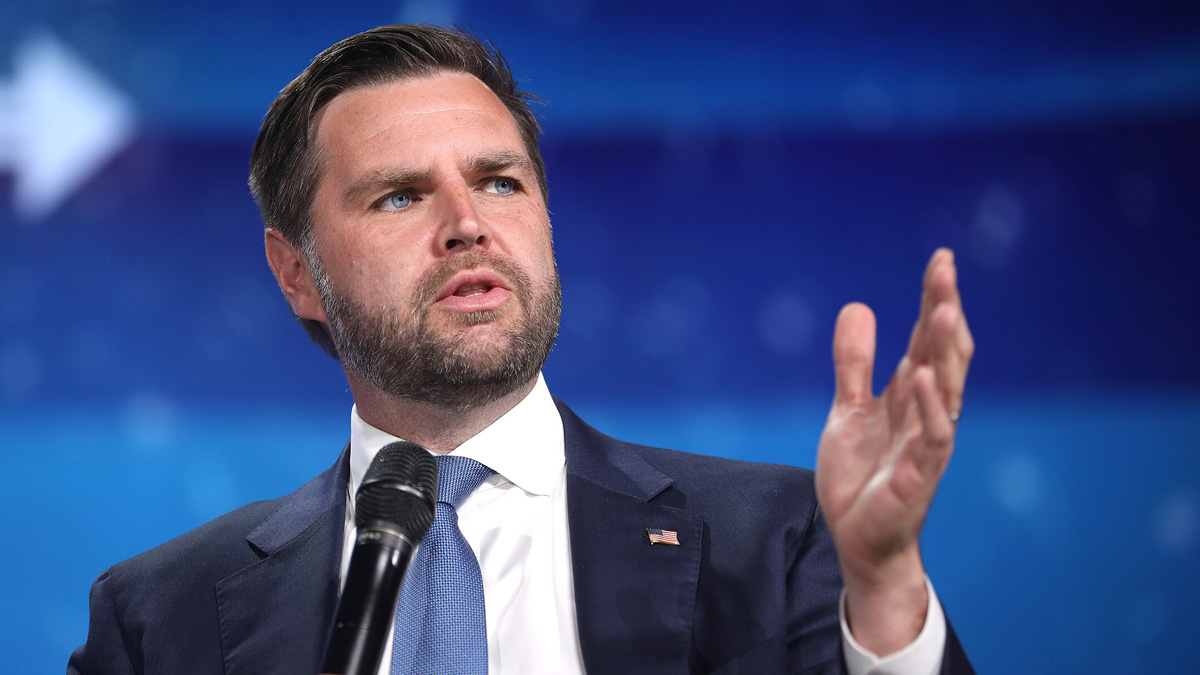
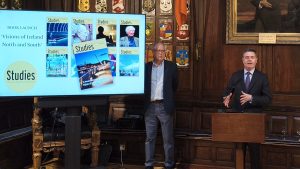
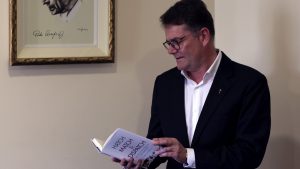
Dr Dermot Roantree, editor of the Jesuit quarterly Studies, featured in the Irish Times this week, Monday 3 November. In the ‘Unthinkable’ column, he explained how the French Catholic philosopher René Girard’s thinking had contributed to the conversion of J.D. Vance to Catholicism. Dr Roantree explains how the now Vice President of the USA has subsequently distorted significantly the work of Girard.
‘Unthinkable’ editor Joe Humphries was prompted to approach Dermot Roantree on foot of the latter’s article in this year’s summer edition of Studies », entitled ‘J.D. Vance, Catholicism, and the postliberal turn’.
You can read Dr Roantree’s interview in the Irish Times by clicking here ». Or, since it was a slightly pared down version of his original response, you can read it in full below.
Q&A on RENÉ GIRARD and J. D. VANCE
When U.S. Vice President J. D. Vance converted to Catholicism in 2019, one of the most important influences on him was the French theorist René Girard, known for his ideas on violence and scapegoating. Dermot Roantree, editor of the Irish Jesuit journal Studies, explains the connection.
Who was René Girard and what was his main contribution to social theory?
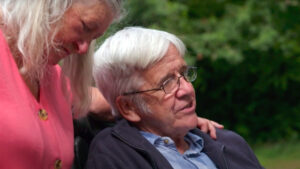
Girard worked across disciplines. He began his academic life as a literary critic, but in studying the great novelists of European literature – Cervantes, Dostoevsky, Flaubert, Proust – he observed a dynamic in human behaviour that he saw as foundational to the emergence of social order, religion, and culture. Tracing this dynamic led him beyond literature into anthropology, sociology, theology, and other adjacent disciplines. He was elected a member of the Académie Française in 2005 and died in 2015.
So, what was this observation?
It was that human desire is imitative: we come to desire things by seeing them desired by others. To use a simple example that Girard himself gave, if you place two toddlers in a room full of toys, as soon as one shows interest in a particular toy, that toy becomes an object of desire for the other. Such mirrored desires lead to rivalry, which in turn gives rise to escalating and contagious violence.
In early societies, Girard held, it was the need to contain this violence that led to sacrificial rituals as a means of purging the source of conflict and restoring social cohesion. Internal conflict would be channeled towards a single target – an innocent scapegoat who would then be cast out or destroyed. This would restore social unity, at least until a new bout of mimetic rivalry started the cycle off again.
As societies evolved, the sacrificial mechanism was transformed into other means of conflict containment that didn’t entail open bloodshed, such as legal systems, civic institutions, and moral or ritual traditions. But these substitutions are fragile. When they weaken or are disregarded, the underlying sacrificial logic re-emerges. Societies revert to building group cohesion by excluding or persecuting the ‘enemy’ – a person perhaps, but often a group, an ideology, or even an historical construct.
Where does religion come into this analysis?
Religion is at the heart of it. Girard held that the earliest rituals and sacrifices served to legitimise the violence of the scapegoat mechanism, representing it as necessary for social order and sanctioned by the gods. Myths and narratives reinforced this idea.
But for Girard, who returned to the Catholicism of his childhood as he developed his anthropology, the Judeo-Christian narrative tradition, while it shares in this mythic structure, at the same time turns it on its head. Uniquely, the Bible takes the side of the victim – think of Job, the Suffering Servant in Isaiah, the lamenting Psalmist, and the widow, orphan and stranger that God’s people were commanded to protect.
Think too of Christ’s passion. That, for Girard, is the ultimate exposure of the fiction, the lie, at the heart of human progress, namely that those we victimise are actually guilty. By revealing this, precisely through his own innocence, Christ deprives the scapegoat mechanism of its power. Which brings on a crisis, of course, as what Christ offers instead is a much more difficult path: it is, Girard says, “the frightening principle that ‘you shall love your neighbour as yourself’.”
How did Girard come to influence JD Vance?
It was the billionaire venture capitalist Peter Thiel who introduced Vance to Girard’s thought. Thiel, who studied under Girard and became Vance’s mentor, found in the concept of mimetic desire a way to understand competition – to see, for example, the value of investing in Facebook, an ideal vehicle for monetizing human imitation and envy. What Vance, for his part, found in Girard was an anthropology that helped explain the web of conflicts, damaged relations, and scapegoating in his Appalachian world and a Christian vision that could break the destructive patterns.
Is Vance reading Girard correctly or misinterpreting him?
Vance understands Girard’s insights well, but his political alignment with Trump has led him to abandon them. Worse, having learned the power of scapegoating, he appears to exploit it rather than expose it. He defended his false claim about Haitian immigrants eating domestic pets by saying, “If I have to create stories so that the American media actually pays attention to the suffering of the American people, then that’s what I’m going to do”.
Vance has vigorously defended Trump’s attacks on his perceived enemies – calls for indictments, imprisonment, exclusion, and censorship. Nothing could be less Girardian. As Girard warned, this is precisely what occurs when the restraints on violence – the rule of law, due process, decentralization of authority, and the preferential option for the victim – are cast aside. Cohesion – in this instance, of the MAGA base – is achieved through scapegoating.
What other Catholic thinkers have shaped Vance’s thinking (and are they compatible with Girard)?
Thiel also appears to have introduced Vance to the thought of the German jurist and Nazi apologist Carl Schmitt. Schmitt, a Catholic, argued that political order requires a strong leader who distinguishes between friends and enemies and acts decisively on that basis, even if it means suspending legal constraints. This logic echoes elements of Project 2025 which Trump, with Vance’s ardent support, is seeking to implement. It could hardly be more distant from the Girardian vision.
This Schmittian perspective is also evident in the Catholic postliberal right – Patrick Deneen, Sohrab Ahmari, and Adrian Vermeule, for example – that had a deep influence on Vance in the lead-up to his conversion and continues to do so.
Vance’s philosophy was publicly criticised by Robert Prevost before he became Pope. From what we know of Leo XIV, are further clashes likely?
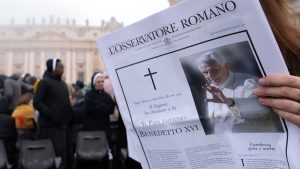
Pope Leo XIV has made it clear, not least in his recent authoritative document Dilexi te, that he shares Pope Francis’s repudiation of Vance’s alarming interpretation of the Christian concept of love to justify mass deportations and other Trumpian policies.
[Dr Dermot Roantree in conversation with Irish Times journalist Joe Humphries.