
Reasons to pray for our dead

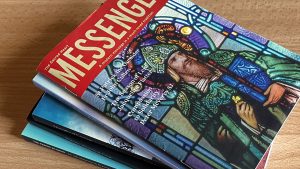
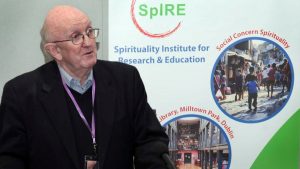
All Souls Day, and the month of November, is traditionally a time to pray for our beloved dead. Theologian Gerry O’Hanlon SJ suggests why we should, in an article reprinted below with kind permission from the November Messenger (2025).
Why Pray for our Dead?
My early memories of All Souls’ Day in November remain with me. As children we scurried in and out of our local church, praying for the release of holy souls from purgatory. Part giggling, but wholly in earnest and even a bit competitively, we stormed heaven with our series of six Our Fathers /Hail Mary’s / Glorias, even feeling a bit guilty as we finally went home for tea, believing that if we had stayed a little longer, we would have rescued even more of those tortured souls.
What remains of that childhood faith? Well, as time went on I began to appreciate the difficulty voiced by
many Protestants around the notion that after death we could continue to make final choices. Isn’t that what this life is about? Isn’t this life where we decide for or against God?
Yet I also began to be informed about the early Christian liturgies, prayers and rituals around prayer for the dead, as well as similar witness from ancient grave stones and sarcophagi. I was impressed by the firm
ness and yet relative reticence and sobriety of church teaching on the issue, leaving speculation to theologians and popular piety. And, besides, and most powerfully, there was the natural, instinctual desire to pray for loved ones who had died, sometimes simply to feel close to them (as the ‘communion of saints’ allows us to be).
Prayer of course, at its deepest, is precisely that: communion. It’s a celebration of our relationship with
God, but, as Scripture makes so clear, it is also prayer of intercession – ‘ask and you shall receive’ (Mt 7:7–8). And, perhaps conscious of our own imperfections, we spontaneously ask for our deceased loved ones to be healed of any remaining imperfections or sins, even after they have died.
How does one understand all this a little more? As I said, speculation is not the way the Church soberly
teaches in this area, showing great respect for the mystery involved, the sense that there are some things we just don’t know yet, and still there are good grounds to trust and believe. Nonetheless it is natural to try to understand a bit more, and the Church at its best respects that.
To understand a little more how praying for the dead can be reasonable, we go back to the basic truth unearthed by many of the sciences and intuitively known to us all, that everything is interconnected: people certainly but also creation, our cosmos. This means that relationship is at the core of reality: we sometimes, mistakenly, imagine that it is the self-sufficient individual. We know this already from the notion of God as Trinity, that original and unsurpassable reality of unity in diversity.
We as human beings are all called to full relationship with the Trinity, with each other, with our planet and our cosmos. Maybe in this life, thanks to God’s grace and mercy, we are enabled to make our basic, fundamental option for God, for this relationship with all. But maybe, too, we do so having broken and damaged many relationships along the way, and are still in need of that healing and reconnection which leads to full reconciliation.
Maybe this is what Purgatory is about, not so much punishment as the full realisation of our failures and
injustices, their cost to others, and yet the way they are healed and repaired through the presence of one another and, above all, through the light and warm gaze of God’s unimaginable and immense love.
I stumble: speculation only goes so far, and still leaves so many questions! Nonetheless I think there is more than enough there to warrant steady adherence to church teaching in this month of November, as we remember and pray for our deceased loved ones and all who have died.
God, to paraphrase Aquinas, could have saved us without needing us to ask, but, out of respect for our human freedom, wanted to treat us with the full dignity of human beings who are not simply ‘done to’. Let us pray for those who have gone before us.
Dr Gerry O’Hanlon SJ
November 2025