
Christian Palestinians and the genocide in Gaza
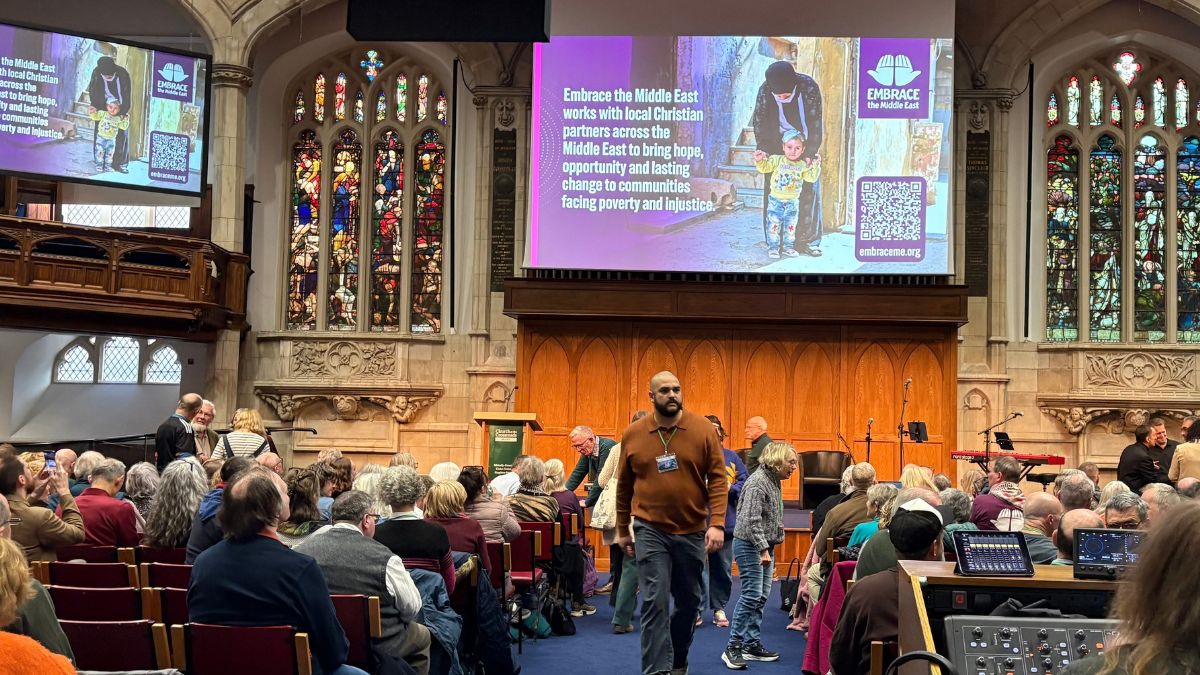
“The Church at the Crossroads conference was a remarkable gathering in that it united all Christian denominations here, in solidarity with their Palestinian brothers and sisters who suffer under illegal occupation. It gave the lie to those who would draw the lines of support for Palestine or Israel neatly along our own sectarian peace wall here in Belfast.” So says Caren Collins, of the Belfast Jesuit Centre » who along with collegues Gerry Clarke SJ, David Byrne, and Pat Coyle of Irish Jesuit Communications were among more than 500 participants who gathered at the Presbyterian Assembly Buildings Conference Centre in Belfast for the Church at the Crossroads conference on 13 and 14 November 2026.
The event brought together Palestinian and global Christian leaders to reflect on the genocide in Gaza and the realities of life in Palestine/Israel, and discuss what a Christ-centered witness requires in the current political climate.
It was part of a global series organised to amplify Palestinian Christian voices, and featured over 20 speakers who reported on the deteriorating situation in Gaza and the West Bank. Through plenary sessions, workshops, and worship, attendees were invited into what organisers described as a biblically grounded dialogue aimed at pursuing peace and justice.
Many of the speakers expressed their concern about how the world in general, including Christian churches, had chosen to ignore the horrific suffering of the Palestine people. And media outlets were happy to peddle propaganda that was unchecked, and unchallenging of the Israeli state and its genocide against the people of Gaza.
These sentiments were evident in the a moving testimony delivered by Dr Tony Deik, Director of Online Education at the Bethlehem Bible College. Dr Deik urged attendees to challenge Israeli propaganda and misinformation, emphasising the responsibility of the global Church to bear witness to the truth.
Along with many other contributors he spoke of the harm done by Christian Zionism, described as a theological and political movement among mainly Protestant Christians that supports the return of Jews to Israel and the modern State of Israel. It is rooted in certain interpretations of the Bible, especially readings that see the restoration of Israel as fulfillment of prophecy and often as a precursor to Christ’s return. Practically it combines religious conviction with political backing (diplomatic, financial, or cultural) for Israeli sovereignty over Palestinian land.
Dr Deik also shared personal reflections on his grandfather’s displacement during the Nakba ( the catastrophe), which was in effect the mass displacement, dispossession, and fracturing of Palestinian society during the 1947–1949 war, around the end of the British Mandate and the establishment of the State of Israel. Dr Deik spoke of the impact of the loss of the family home in Bethlehem at that time. He outlined the ongoing injustices perpetrated against the Palestinian people today, and advocated for a response rooted in the theological mandate to “love God and love your neighbour.”
As noted by Caren Collins, “It was truly heartening to hear speakers from so many Christian denominations reject, so utterly, a theology that justifies the dispossession, torture and death of any people, in the way that Christian Zionism does. The Gospel remained front and centre throughout, with Jesus commandment to love God and love our neighbour as ourself reiterated by almost every speaker.”
In direct contrast to a Christian theology of Zionism Dr Salim Munyar, also of the Bethlehem Bible College, presented on the “Theology of Exile in the shadow of Gaza.” Drawing parallels to Psalm 137, Munyar discussed the impact of displacement and the ethnic cleansing of Palestinians, while stressing that solidarity, however small, remains a vital act of witness. He reminded participants that “God is where the wounded are,” and said that in these days, God is with the people in the flooded tents of Gaza.
One comment in particular from Dr Munyar struck Pat Coyle of Irish Jesuit Communications. “He was talking about the unspeakable suffering of the Palestinian people today and he cautioned against Christians rushing too quickly to ask, ‘But have you hope?” reports Pat, adding, “And then he looked at the audience and said quietly, ‘Please please, first give us time to lament.”
Because of his plea Pat Coyle was prompted to attend a workshop, conducted by Presbyterian Minister Karen Campbell on the psalms of lamentation in the context of the 30 years of war in Northern Ireland. “Karen consulted with groups all across the North. Each group ended up choosing a psalm that spoke to their community and it’s suffering, and the Karen and her husband composed the music for it. We sang the psalms in the workshop. It was incredibly moving.”
Truly moving also, according to Caren Collins, was the testimony of Mira Mobarak, a 14 yearold Lebanese school girl who spoke along with her father Mohammad. “The Palestinian speakers were remarkable in their own lack of bitterness towards their oppressors. A watershed moment for me however, was listening to the testimony of 14 year old Mira, who told of the murder of her beloved aunt, killed by an Israeli drone in front of her two year old son,” say Caren, adding, “Mira has had to grow up fast and indeed, she spoke with a maturity, sensitivity and authority that belied her 14 years and brought the room to its feet and to tears.”
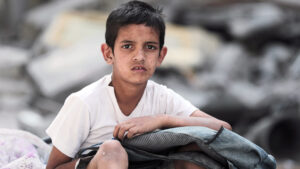
Throughout the two-day event, speakers repeatedly drew attention to the humanitarian catastrophe in Gaza, citing reports of indiscriminate attacks on civilian infrastructure, including homes, schools, hospitals, and refugee camps, alongside the continued obstruction of life-saving aid. Participants were cautioned against the dangers of Christian Zionism and the misinterpretation of Scripture, which speakers argued have contributed to the total discrimination against Palestinians by the Israeli government.
The event encouraged attendees to study the message of Kairos Palestine 11: A Moment of Truth: Faith in a Time of Genocide ». There was also a call for increased physical solidarity, with attendees invited to consider travelling to the Holy Land to stand with the declining Palestinian Christian population.
Siobhán Garrigan, a professor of Theology and Social Justice at Trinity College Dublin, explored themes of interconnectedness and belonging. Using St. Paul’s theology of the Body, she highlighted that when one part of the body suffers, the entire community feels the pain, urging a deeper sense of unity and shared responsibility.
In the conference’s closing liturgy, Palestinian pastor and author of Christ in the Rubble, Munther Isaac, reflected on the figure of Mary, the mother of Jesus. He presented her as a courageous model for the present day, describing her as a young woman who said “Yes” to God amidst extremely difficult circumstances.
The event was supported by numerous ecumenical and social justice organisations in Ireland, including the Belfast Jesuit Centre, Trócaire, Christian Aid, Pax Christi, and the Irish Jesuit Province. Further events in the Church at the Crossroads series are scheduled to take place in Sydney in February 2027 and Auckland in March 2027.
Pat Coyle of Irish Jesuit Communications conducted a number of interviews with various conference speakers over the two days. Over the coming weeks they will be posted on the IJC podcast series on the the Irish Jesuit website and in Irish Jesuit News. One interview includes those who gave a presentation on the Palestine – Ireland Ecumenical Twinning Alliance involving, among other groups, the Belfast Jesuit Centre, in partnership with churches in Taybeh and Bethlehem.
For more information on the conference and its organisers, visit this site »