
Honouring children killed in Gaza
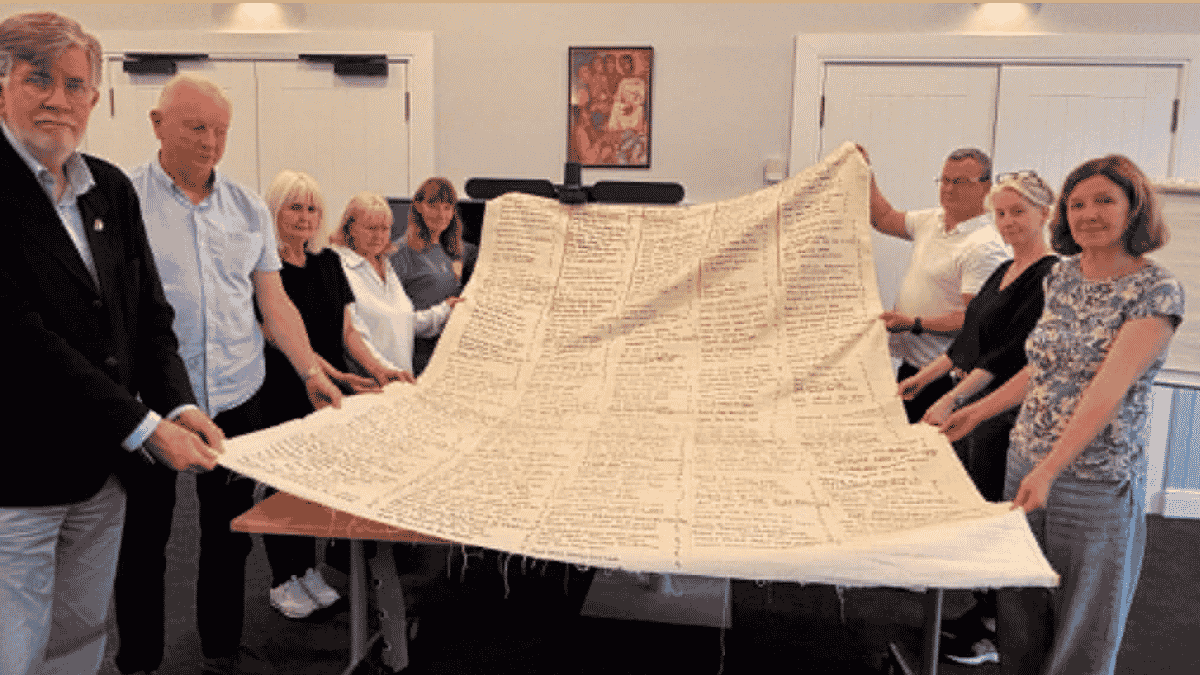
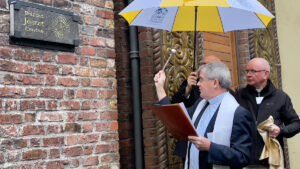
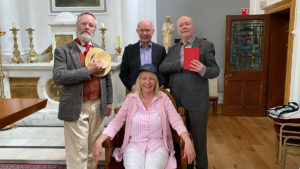
The Belfast Jesuit Centre hosted a signing of the Shroud of Remembrance — a solemn, communal act in which people encountered and honoured the name of a deceased Palestinian child. The event on Tuesday 28 July 2026, was part of one of Priests Against Genocide‘s first international projects and seen as a gesture designed to mark and resist the erasure of human life amid conflict.
The Shroud of Remembrance is a large, intentionally stark white cloth, divided into boxes and accompanied by lists of children’s names. Across participating countries, communities have been invited to write a name, to pause, and to hold the child in memory. The project recognises at least 20,000 children known to have died in Gaza; organisers stress the true number is likely higher. Ireland received a shroud containing 450 names — each of them recorded as nine years old. The largest recorded cohort of child victims in Gaza is said to have been three years old.
Caren Collins of the Belfast Jesuit Centre says that in the face of atrocity, remembrance is itself a form of resistance. The Shroud of Remembrance insists that every child’s name is worth writing, saying, and holding in collective memory. When the Irish shroud joins others from around the world, it will form part of a vast, collective memorial — a testament both to lives taken needlessly and to a global community committed to remembering them.
In Ireland, the shroud was entrusted to Fr Pat Colgan, Director of Priests Against Genocide in Ireland. Working with Michael, Caitriona and Roisin Malone of Christians4Palestine, and Gaels Against Genocide, Fr Pat has overseen the shroud’s journey from parish to parish and from solidarity group to solidarity group. Their aim has been to create spaces where ordinary people, parishioners and activists alike can conduct this act of remembrance in ways that are respectful, contextualised and communal.
At the Belfast Jesuit Centre, the scale of the shroud and the weight of the names drew people to move slowly and deliberately. Participants were given a single name to sign. Many paused to sound it out, trace its letters, and imagine the life that had been cut short. According to Caren, “The emotional response was unmistakable. Some wept, others stepped back in silence, and many offered prayers.” In those shared moments, the shroud became a vessel for grief and for solidarity — a place where feeling could be given form when words felt insufficient.
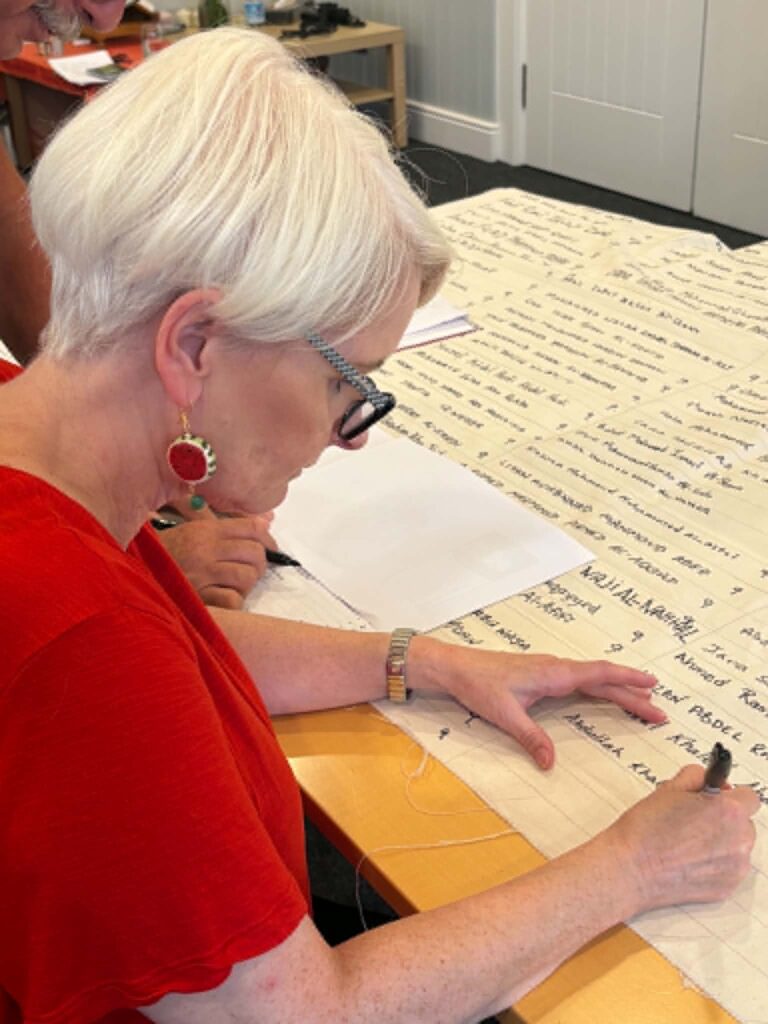
Words did play a role at the signing. Caitriona Malone read aloud Mohammed, a poem by Karen Berry written in response to the shroud-signing experience. Mohammed was from the Deir al-Balah governorate, in the Gaza Strip, between Gaza City and Khan Younis. On 8 June 2024, he was killed by Israel’s armed forces. The poem, which you can read in full below, and a subsequent musical tribute, transformed a private encounter into a public witness. Nuala Murray, a musician who signed the shroud in the Belfast Jesuit Centre, composed a harp piece dedicated to the child whose name she had written. She explained that the opening notes reference the name Abdel and echo an Irish air, folding memory and cultural expression into a single act of remembrance.
Ireland’s involvement is one thread in a global tapestry of responses. In cities and towns around the world, the shroud has been signed at vigils, prayer circles, public gatherings and quiet kitchen‑table memorials. Each signature is a refusal to let these children become only statistics; each name insists on human dignity, individuality and loss.
Fr Pat, Michael, Caitriona and Roisin have emphasised that the shroud is not merely a display but a mediated encounter: accompanied, explained, and treated with dignity. That stewardship has enabled people to express grief safely and to translate sorrow into a moral, embodied solidarity.
Caren Collins explains that the Shroud of Remembrance is not only a record of loss, but also a gesture toward “a hope that refuses to be extinguished; a belief that love endures even in the face of atrocity; a trust that remembrance can help bend the world toward justice.” It proclaims that these children are created in God’s image and likeness and are infinitely precious. “And though lost to this world, are never lost to God. As Isaiah proclaims: ‘He will destroy the shroud that enfolds all peoples; the sheet that covers all nations. He will swallow up death forever’.”
Mohammed
Mohammed Suleiman Akram Al-Sardi
The sun never rose on your tenth birthday,
because you were never given one.
You did not live to count in double figures.
Like every child, you carried tomorrow inside you.
Who did you dream of becoming?
A teacher?
A doctor?
A footballer?
Or had you not yet decided,
because childhood should never hurry?
Did you chase a football through dusty streets?
Laugh with your friends until your mother called you home?
What meal made you run home faster?
How many voices filled your family home?
I hope some of those voices are still here
still speaking your name so time cannot erase it.
Yesterday, I wrote your name on a shroud –
a shroud divided into twenty thousand boxes,
each waiting for the name of a child,
so the world cannot say
it did not know.
Twenty thousand names.
Twenty thousand stolen futures.
Twenty thousand living gifts to the world.
Twenty thousand names.
And yours is one of them.
Mohammed Suleiman Akram Al-Sardi –
I want to tell you –
you are not a statistic.
Not a tally.
Not another number
added to a growing count.
You were a child.
And while your name is spoken,
you will remain
far more
than a number.
Karen Berry