
November Messenger: Why pray for the dead?
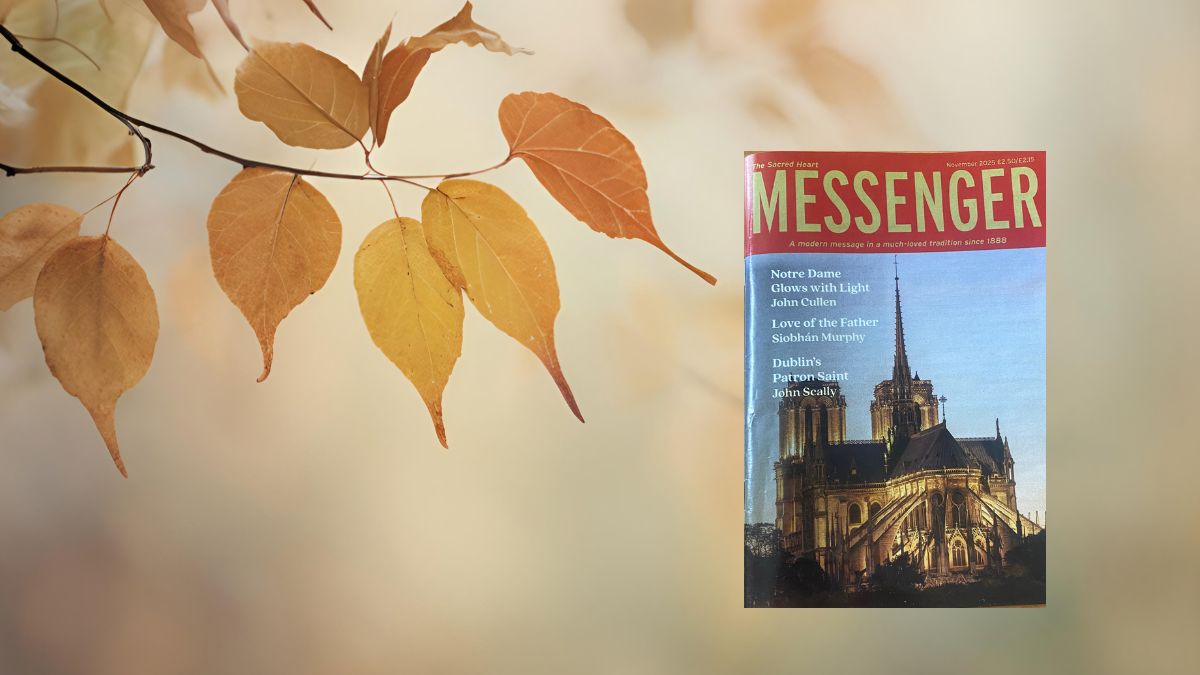
Donal Neary SJ’s opening article in this month’s November Messenger reflects on the meaning of all Souls’ Day. He says, “It is good to remember our dead and to be grateful for their lives.” He adds that “those who die bring with them the loves of their life, and so something of us goes with them – a link between heaven and earth”. Donal also reminds us that faith gives meaning to death and Jesus, who “is God made man, offers not an answer but a meaning to death. It is a meeting with God, a homecoming, an entry into a totally new way of life.”
Jesuit theologian Gerry O’Hanlon asks ‘Why Pray for the Dead?‘ In his article, he remembers his early years during All Souls’ Day in November. He reflects, “As children, we scurried in and out of our local church, praying for the release of holy souls from purgatory. Part giggling, but wholly earnest and even a bit competitively, we stormed heaven with our series of six Our Fathers/Hail Marys/Glorias, even feeling a bit guilty as we went home for tea. Gerry continues, “to understand a little more about how praying for the dead can be reasonable, we go back to the basic truth unearthed by many sciences and intuitively known to us all, that everything is interconnected, people certainly, but also creation, our cosmos. This means that relationship is at the core of reality. We as human beings are all called to full relationship with the Trinity, with each other, with our planet, and our cosmos. Let us pray for those who have gone before us.” Click here to read the full article »
These articles are complemented by a moving article from Spiritual Director Siobhan Murphy on her deceased father, whose presence is clearly sensed by her in these November days.
Kevin O’Gorman SMA shares the Pope’s intention for the month: “That those who are tempted to commit suicide might find the support, care, and love they need in their community and be open to the beauty of life”. Commenting on the intention, Kevin says, “The strain of economic and social pressure can pile up to push some people over the edge of existence. The sadness of families who have lost a loved one through suicide is shared to different degrees by their relatives and friends, colleagues, and community. Suicide leaves nobody untouched.” Kevin concludes that “As we remember this month those who have died tragically by their own hands, we pray also that we may promote awareness of and action for the prevention of suicide”.
Colm Brophy is a former Jesuit and artist and art therapist. He has written a piece for this November Messenger entitled ‘We All Belong’. In it he reflects on the suffering of children of war and, in particular, the “lost children of Palestine”. He says, “We have seen the obscene television news, night after night, until we could look at it no more. Our children have been crucified by starvation, bereavement of their parents and siblings. We have felt so helpless.”
Colm continues, “Every human being deserves our respect, our care, and positive thoughts. No one is alien. No one is alien except ourselves when we fall into the trap of thinking that our way of being is better than those who appear strange to us, poor, politically left, right, or centre, of a different religion, or no religion. Everyone has within them an abundance of goodness and of possibility. Love our enemy, open our hearts. Are we no better than the stranger? especially when we think we are?”
David Breen continues his series on Scripture. This month, he focuses on the story of ‘The Cost of Discipleship’. He reminds us of Jesus’ journey to Jerusalem for Passover, where his mission would climax in death and resurrection. David explains, “Jesus turned to the crowd and laid out two conditions for discipleship. One of these conditions is ‘hatred’ for parents, wives, siblings, and children”. David explains that “hatred in this context is a semitic idiom signifying what is secondary in a decisive choice. Jesus’ use of this idiom is to stress that unless our relationship with him takes priority over others, we cannot be his disciple.”
The second condition that the disciple take up his or her cross and follow Jesus is a repetition of Luke 9:23. Davis continues, “The cross for the disciple is the consequence of being a follower of Jesus. Putting Jesus before all other relationships and living a life of renunciation are only ways of describing what is involved in taking up our cross. In Jesus’ day, those who took up the cross had already said goodbye to family and friends and relinquished their possessions. Discipleship is cruciform. It costs us everything, just as our salvation cost Jesus everything”. David concludes, “God grant us the grace to truly follow Jesus”.
Other interesting stories in this edition of the Messenger include ‘Religion is still a thing’ by Father Gerard Condon, which explores the topic of Gen Z, religion, and an exciting turnaround in Church attendance. ‘Ireland and India’ is a reflection by Kevin Hargaden of the JCFJ on the deep unrest among the Irish-Indian community here in light of the hostility their members have recently received. And ‘Dublin’s Patron Saint’, Laurence O’Toole is the focus of attention this month for John Scally.
The Messenger also features its regular selections, including reflections, scripture, cookery, crosswords, children’s pages, nature focus, and RE:LINK.